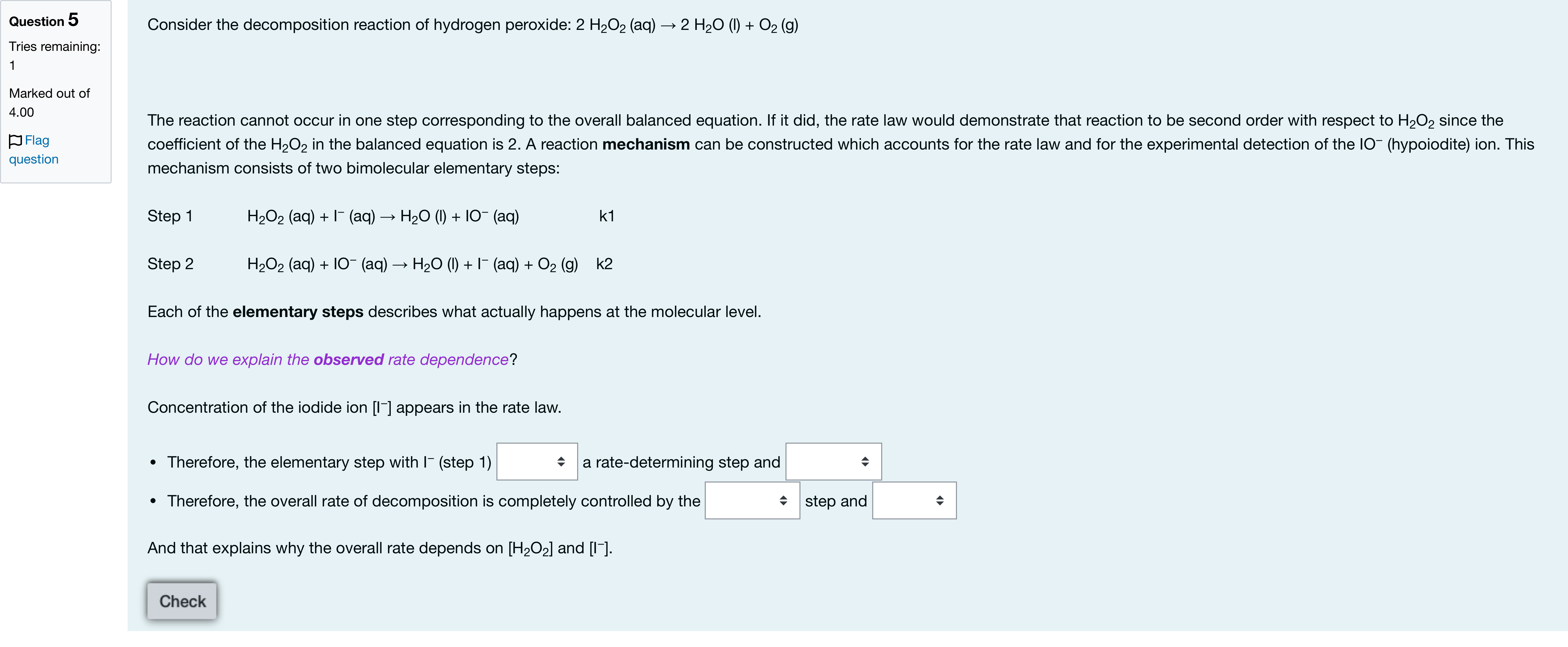
Question textConsider the decomposition reaction of hydrogen peroxide: 2 H2O2 (aq) → 2 H2O (l) + O2 (g) The reaction cannot occur in one step corresponding to the overall balanced equation. If it did, the rate law would demonstrate that reaction to be second order with respect to H2O2 since the coefficient of the H2O2 in the balanced equation is 2. A reaction mechanism can be constructed which accounts for the rate law and for the experimental detection of the IO− (hypoiodite) ion. This mechanism consists of two bimolecular elementary steps: Step 1 H2O2 (aq) + I− (aq) → H2O (l) + IO− (aq) k1 Step 2 H2O2 (aq) + IO− (aq) → H2O (l) + I− (aq) + O2 (g) k2 Each of the elementary steps describes what actually happens at the molecular level. How do we explain the observed rate dependence? Concentration of the iodide ion [I−] appears in the rate law. Therefore, the elementary step with I− (step 1) Answer 1 Question 5[select: , is, is not] a rate-determining step and Answer 2 Question 5[select: , k1 ≪ k2, k1 ≫ k2, k1 = k2] Therefore, the overall rate of decomposition is completely controlled by the Answer 3 Question 5[select: , first, second] step and Answer 4 Question 5[select: , k = k1, k = k2] And that explains why the overall rate depends on [H2O2] and [I−].Check Question 5Multiple fill-in-the-blank
Log in for full answers
We've collected over 50,000 authentic original questions and detailed explanations from around the globe. Log in now and get instant access to the answers!
Similar Questions
Consider the tabulated data collected for the reaction 2N2O(g) → 2N2(g) + O2(g) at 500 °C. The rate law for this reaction is rate = k[N2O]. Time (s) [N2O] (M) 0 0.2400 61.9 0.1200 123.8 0.0600 185.7 0.0300 What is the value of the rate constant (without its unit) at this temperature?
A drug with concentration 0.90 M decomposes via acid-catalysed hydrolysis with a rate constant of 0.031 M−1 h−1. What is the shelf-life of this drug in hours? Report your answer to 2 significant figures.
The rate of hydrolysis of a compound A is measured in mol/(L × h). Express the rate of 0.61 mol/(L × h) in g/(mL × s). The molar mass of compound A is 280 g/mol.
A new drug candidate has been developed and the rate constant for its base-catalysed hydrolysis has been was found to vary with temperature. The rate constant at 25 °C was determined to be 1.053 × 10⁻³ h-1. Which formulation and storage recommendations, of the ones listed below, are appropriate?
More Practical Tools for Students Powered by AI Study Helper
Making Your Study Simpler
Join us and instantly unlock extensive past papers & exclusive solutions to get a head start on your studies!