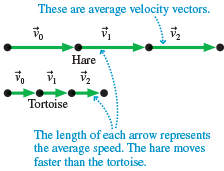
Referring to Figure 1.10 in Chapter 1 of the text (reproduced below), compare the magnitudes of the average accelerations for Hare and the Tortoise. 单项选择题
A
The Hare has a larger average acceleration than the Tortoise
B
The Tortoise has a larger average acceleration than the Hare
C
The Tortoise and the Hare have the same average acceleration
D
There is not enough information to choose one of the other answers
登录即可查看完整答案
我们收录了全球超50000道真实原题与详细解析,现在登录,立即获得答案。
类似问题
Question at position 3 In Example 16 (p. 49), what is the cyclist's average acceleration for the entire trip (i.e., from 0 s to 1800 s)? -2 ms2\frac{m}{s^2}-1 ms2\frac{m}{s^2}-0.0006 ms2\frac{m}{s^2}0 ms2\frac{m}{s^2}0.0006 ms2\frac{m}{s^2}1 ms2\frac{m}{s^2}2 ms2\frac{m}{s^2}Clear my selection
Referring to Figure 1.10 in Chapter 1 of the text (reproduced below), compare the magnitudes of the average accelerations for Hare and the Tortoise.
Calculate average acceleration from 0 to 40 m. NOTE: SI unit symbol must be provided and round to three (3) significant figures.
A car increases its speed from 9.5 meters per second to 13.6 meters per second in 3.3 seconds. What is the average acceleration of the car during this time interval?
更多留学生实用工具
希望你的学习变得更简单
加入我们,立即解锁 海量真题 与 独家解析,让复习快人一步!