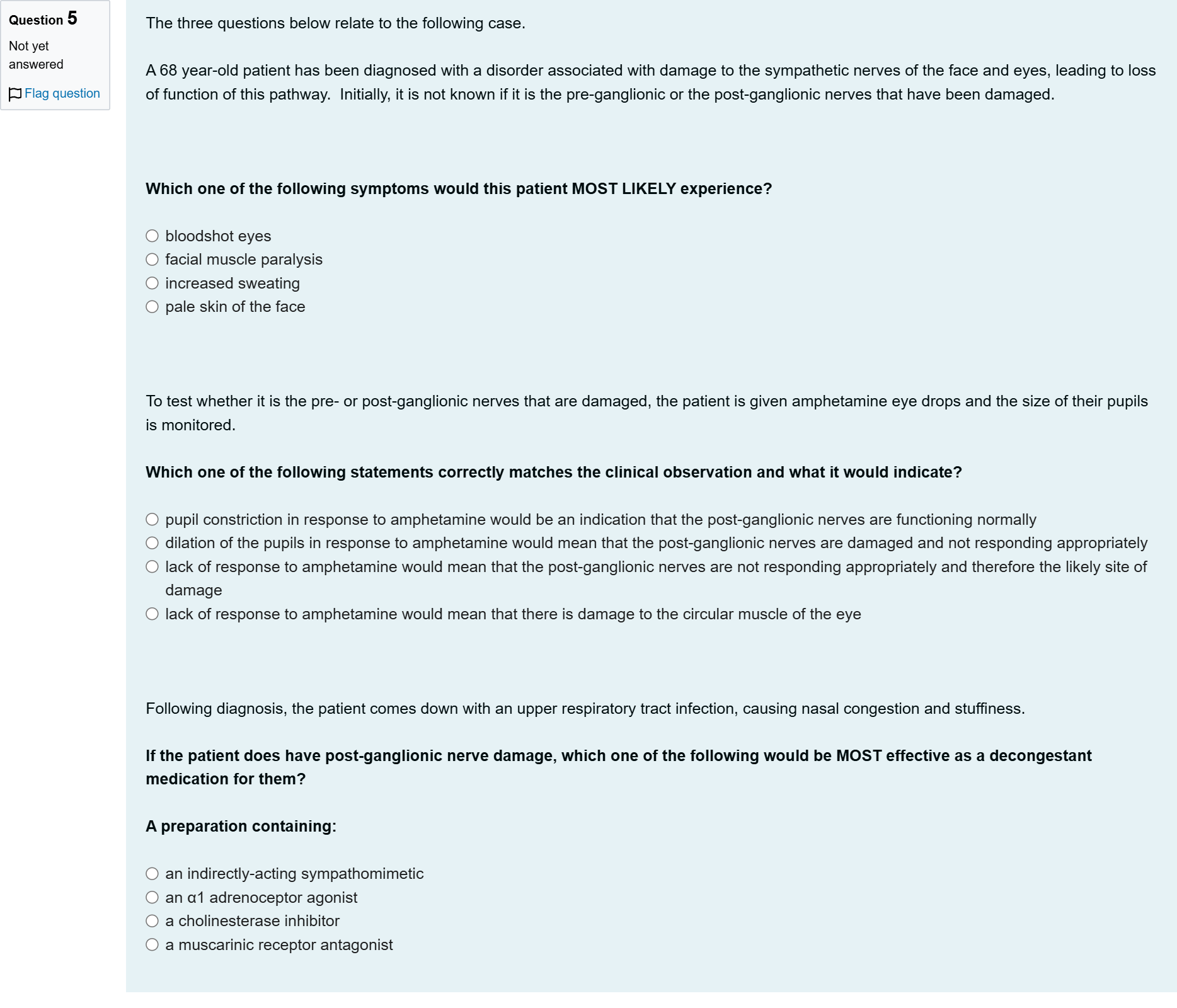
Question textThe three questions below relate to the following case. A 68 year-old patient has been diagnosed with a disorder associated with damage to the sympathetic nerves of the face and eyes, leading to loss of function of this pathway. Initially, it is not known if it is the pre-ganglionic or the post-ganglionic nerves that have been damaged. Which one of the following symptoms would this patient MOST LIKELY experience? Multiple choice 1 Question 5bloodshot eyesfacial muscle paralysisincreased sweatingpale skin of the face To test whether it is the pre- or post-ganglionic nerves that are damaged, the patient is given amphetamine eye drops and the size of their pupils is monitored. Which one of the following statements correctly matches the clinical observation and what it would indicate? Multiple choice 2 Question 5pupil constriction in response to amphetamine would be an indication that the post-ganglionic nerves are functioning normallydilation of the pupils in response to amphetamine would mean that the post-ganglionic nerves are damaged and not responding appropriatelylack of response to amphetamine would mean that the post-ganglionic nerves are not responding appropriately and therefore the likely site of damagelack of response to amphetamine would mean that there is damage to the circular muscle of the eye Following diagnosis, the patient comes down with an upper respiratory tract infection, causing nasal congestion and stuffiness. If the patient does have post-ganglionic nerve damage, which one of the following would be MOST effective as a decongestant medication for them? A preparation containing: Multiple choice 3 Question 5an indirectly-acting sympathomimetican α1 adrenoceptor agonista cholinesterase inhibitora muscarinic receptor antagonist多项填空题
登录即可查看完整答案
我们收录了全球超50000道真实原题与详细解析,现在登录,立即获得答案。
类似问题
The sympathetic nervous system ...
An increase in blood pressure (BP) is likely to result in an increased parasympathetic nervous system outflow and decreased sympathetic nervous system outflow.
Muscarine is a poison found in some poisonous mushrooms. Muscarine binds to acetylcholine receptors and mimics its action. Which of the following describes the effect of muscarine?
Which ONE of the following functions is not affected by the parasympathetic nervous system?
更多留学生实用工具
希望你的学习变得更简单
加入我们,立即解锁 海量真题 与 独家解析,让复习快人一步!