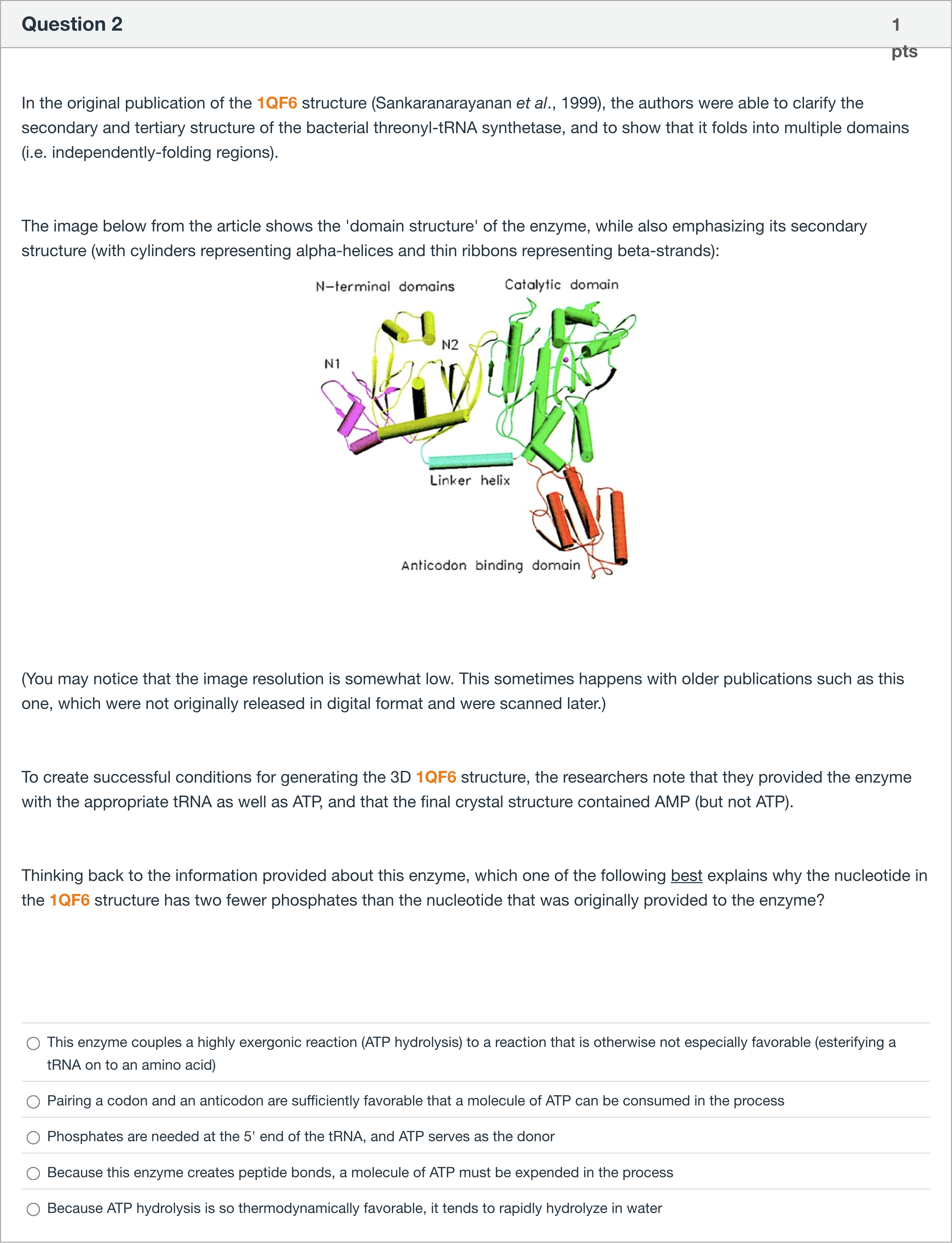
In the original publication of the 1QF6 structure (Sankaranarayanan et al., 1999), the authors were able to clarify the secondary and tertiary structure of the bacterial threonyl-tRNA synthetase, and to show that it folds into multiple domains (i.e. independently-folding regions). The image below from the article shows the 'domain structure' of the enzyme, while also emphasizing its secondary structure (with cylinders representing alpha-helices and thin ribbons representing beta-strands): (You may notice that the image resolution is somewhat low. This sometimes happens with older publications such as this one, which were not originally released in digital format and were scanned later.) To create successful conditions for generating the 3D 1QF6 structure, the researchers note that they provided the enzyme with the appropriate tRNA as well as ATP, and that the final crystal structure contained AMP (but not ATP). Thinking back to the information provided about this enzyme, which one of the following best explains why the nucleotide in the 1QF6 structure has two fewer phosphates than the nucleotide that was originally provided to the enzyme? 单项选择题
A
This enzyme couples a highly exergonic reaction (ATP hydrolysis) to a reaction that is otherwise not especially favorable (esterifying a tRNA on to an amino acid)
B
Pairing a codon and an anticodon are sufficiently favorable that a molecule of ATP can be consumed in the process
C
Phosphates are needed at the 5' end of the tRNA, and ATP serves as the donor
D
Because this enzyme creates peptide bonds, a molecule of ATP must be expended in the process
E
Because ATP hydrolysis is so thermodynamically favorable, it tends to rapidly hydrolyze in water
登录即可查看完整答案
我们收录了全球超50000道真实原题与详细解析,现在登录,立即获得答案。
类似问题
An enzyme known as ___________ attaches an amino acid to the of a tRNA, thereby producing …………………
Assume a mutation in the CCA arm of tRNAThr occurs that reduces the flexibility of this region of the molecule but still allows the 3′ end of the tRNA to enter the aminoacyl-tRNA synthetase activation site. Which of the following is the most likely outcome?
Two distinct classes of aminoacyl-tRNA synthetases exist. What might explain this? Please choose the correct answer from the following choices,
Question9Question 9Inline Choice Question Try selecting one of the choices from the drop down menu: The capital of New South Wales is [select: , Tasmania, Brisbane, Sydney, Melbourne]. ResetMaximum marks: 1 Flag question undefined
更多留学生实用工具
希望你的学习变得更简单
加入我们,立即解锁 海量真题 与 独家解析,让复习快人一步!