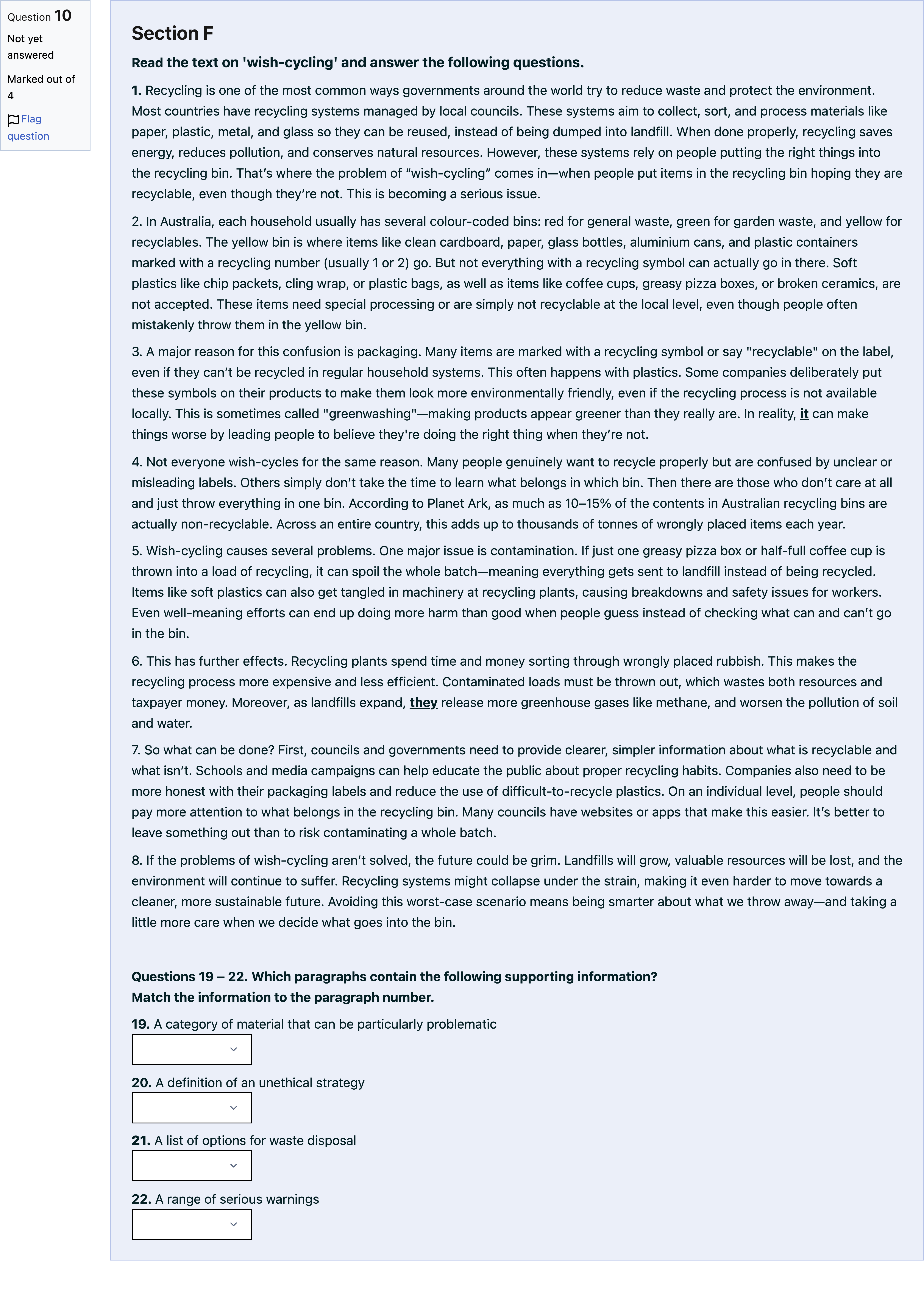
Question textSection FRead the text on 'wish-cycling' and answer the following questions. 1. Recycling is one of the most common ways governments around the world try to reduce waste and protect the environment. Most countries have recycling systems managed by local councils. These systems aim to collect, sort, and process materials like paper, plastic, metal, and glass so they can be reused, instead of being dumped into landfill. When done properly, recycling saves energy, reduces pollution, and conserves natural resources. However, these systems rely on people putting the right things into the recycling bin. That’s where the problem of “wish-cycling” comes in—when people put items in the recycling bin hoping they are recyclable, even though they’re not. This is becoming a serious issue. 2. In Australia, each household usually has several colour-coded bins: red for general waste, green for garden waste, and yellow for recyclables. The yellow bin is where items like clean cardboard, paper, glass bottles, aluminium cans, and plastic containers marked with a recycling number (usually 1 or 2) go. But not everything with a recycling symbol can actually go in there. Soft plastics like chip packets, cling wrap, or plastic bags, as well as items like coffee cups, greasy pizza boxes, or broken ceramics, are not accepted. These items need special processing or are simply not recyclable at the local level, even though people often mistakenly throw them in the yellow bin. 3. A major reason for this confusion is packaging. Many items are marked with a recycling symbol or say "recyclable" on the label, even if they can’t be recycled in regular household systems. This often happens with plastics. Some companies deliberately put these symbols on their products to make them look more environmentally friendly, even if the recycling process is not available locally. This is sometimes called "greenwashing"—making products appear greener than they really are. In reality, it can make things worse by leading people to believe they're doing the right thing when they’re not. 4. Not everyone wish-cycles for the same reason. Many people genuinely want to recycle properly but are confused by unclear or misleading labels. Others simply don’t take the time to learn what belongs in which bin. Then there are those who don’t care at all and just throw everything in one bin. According to Planet Ark, as much as 10–15% of the contents in Australian recycling bins are actually non-recyclable. Across an entire country, this adds up to thousands of tonnes of wrongly placed items each year. 5. Wish-cycling causes several problems. One major issue is contamination. If just one greasy pizza box or half-full coffee cup is thrown into a load of recycling, it can spoil the whole batch—meaning everything gets sent to landfill instead of being recycled. Items like soft plastics can also get tangled in machinery at recycling plants, causing breakdowns and safety issues for workers. Even well-meaning efforts can end up doing more harm than good when people guess instead of checking what can and can’t go in the bin. 6. This has further effects. Recycling plants spend time and money sorting through wrongly placed rubbish. This makes the recycling process more expensive and less efficient. Contaminated loads must be thrown out, which wastes both resources and taxpayer money. Moreover, as landfills expand, they release more greenhouse gases like methane, and worsen the pollution of soil and water. 7. So what can be done? First, councils and governments need to provide clearer, simpler information about what is recyclable and what isn’t. Schools and media campaigns can help educate the public about proper recycling habits. Companies also need to be more honest with their packaging labels and reduce the use of difficult-to-recycle plastics. On an individual level, people should pay more attention to what belongs in the recycling bin. Many councils have websites or apps that make this easier. It’s better to leave something out than to risk contaminating a whole batch. 8. If the problems of wish-cycling aren’t solved, the future could be grim. Landfills will grow, valuable resources will be lost, and the environment will continue to suffer. Recycling systems might collapse under the strain, making it even harder to move towards a cleaner, more sustainable future. Avoiding this worst-case scenario means being smarter about what we throw away—and taking a little more care when we decide what goes into the bin. Questions 19 – 22. Which paragraphs contain the following supporting information? Match the information to the paragraph number.19. A category of material that can be particularly problematic Answer 1 Question 10[select: , Paragraph 1, Paragraph 2, Paragraph 3, Paragraph 4, Paragraph 5, Paragraph 6, Paragraph 7, Paragraph 8] 20. A definition of an unethical strategy Answer 2 Question 10[select: , Paragraph 1, Paragraph 2, Paragraph 3, Paragraph 4, Paragraph 5, Paragraph 6, Paragraph 7, Paragraph 8] 21. A list of options for waste disposal Answer 3 Question 10[select: , Paragraph 1, Paragraph 2, Paragraph 3, Paragraph 4, Paragraph 5, Paragraph 6, Paragraph 7, Paragraph 8] 22. A range of serious warnings Answer 4 Question 10[select: , Paragraph 1, Paragraph 2, Paragraph 3, Paragraph 4, Paragraph 5, Paragraph 6, Paragraph 7, Paragraph 8]Multiple fill-in-the-blank
Log in for full answers
We've collected over 50,000 authentic original questions and detailed explanations from around the globe. Log in now and get instant access to the answers!
Similar Questions
What was an environmental dilemma described in Lecture 4?
Which of the following were waste disposal systems discussed in Lecture 4?
27. Most commonly, contaminated recyclable material increases the size of Answer Question 21[input].
26. Plastic bags can damage recycling machinery, which is Answer Question 20[input] to fix.
More Practical Tools for Students Powered by AI Study Helper
Making Your Study Simpler
Join us and instantly unlock extensive past papers & exclusive solutions to get a head start on your studies!