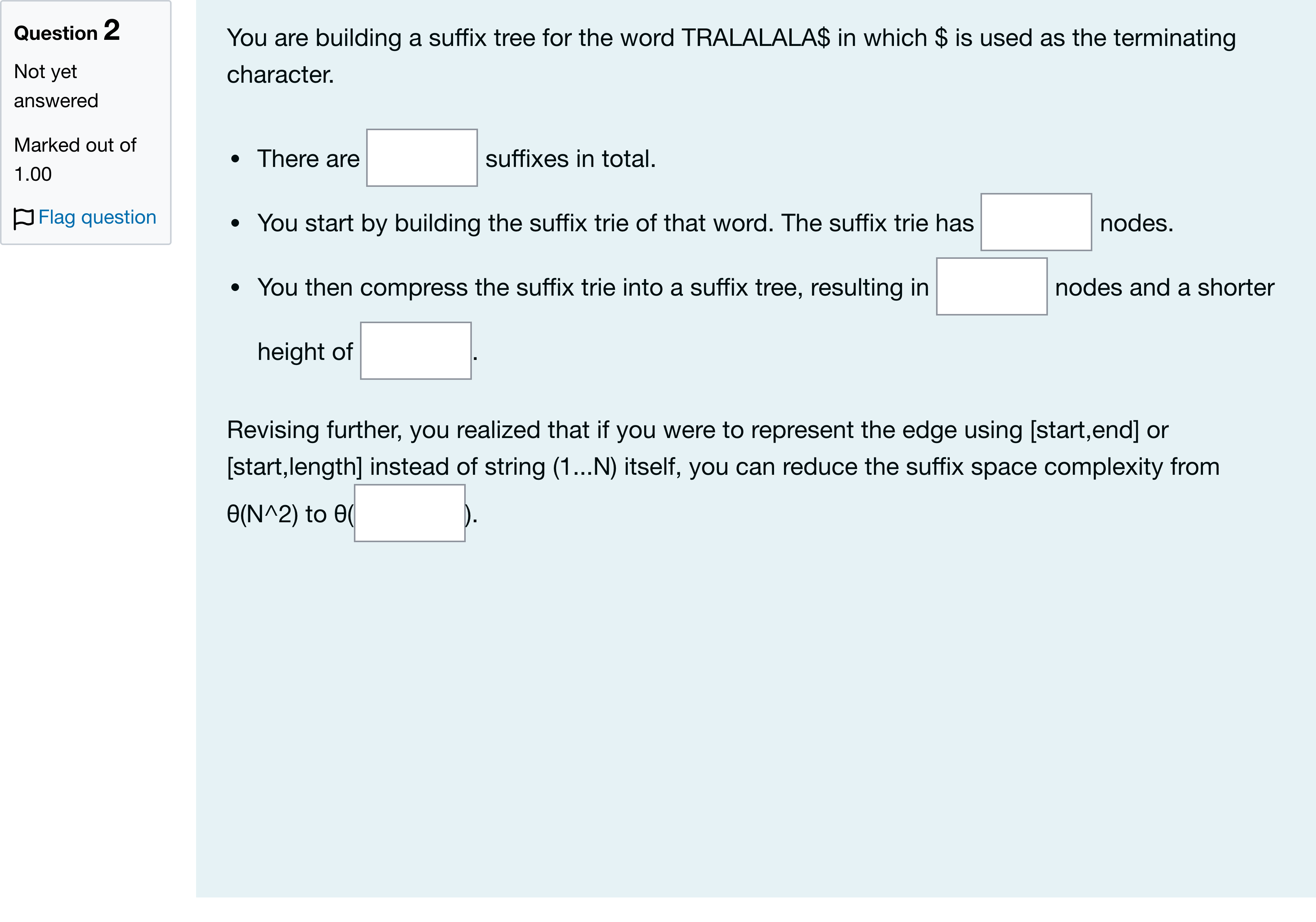
Question text You are building a suffix tree for the word TRALALALA$ in which $ is used as the terminating character.There are Answer 1 Question 2[input] suffixes in total. You start by building the suffix trie of that word. The suffix trie has Answer 2 Question 2[input] nodes. You then compress the suffix trie into a suffix tree, resulting in Answer 3 Question 2[input] nodes and a shorter height of Answer 4 Question 2[input]. Revising further, you realized that if you were to represent the edge using [start,end] or [start,length] instead of string (1...N) itself, you can reduce the suffix space complexity from θ(N^2) to θ(Answer 5 Question 2[input]).Multiple fill-in-the-blank
Log in for full answers
We've collected over 50,000 authentic original questions and detailed explanations from around the globe. Log in now and get instant access to the answers!
Similar Questions
Question textYou are building a suffix tree for the word CCBBABABA$ in which $ is used as the terminating character. Recall that $ is always a suffix. Make sure to count the root node as one of the nodes. There are Answer 1 Question 1[input] suffixes in total. You start by building the suffix trie of that word. The suffix trie has Answer 2 Question 1[input] nodes. You then compress the suffix trie into a suffix tree, resulting in Answer 3 Question 1[input] nodes and a height of Answer 4 Question 1[input]. Check Question 1
Question textYou are building a suffix tree for the word CCBBABABA$ in which $ is used as the terminating character. Recall that $ is always a suffix. Make sure to count the root node as one of the nodes. There are Answer 1 Question 1[input] suffixes in total. You start by building the suffix trie of that word. The suffix trie has Answer 2 Question 1[input] nodes. You then compress the suffix trie into a suffix tree, resulting in Answer 3 Question 1[input] nodes and a height of Answer 4 Question 1[input].
Question textYou are building a suffix tree for the word CCCCBCCCA$ in which $ is used as the terminating character. Recall that $ is always a suffix. Make sure to count the root node as one of the nodes. There are Answer 1 Question 1[input] suffixes in total. You start by building the suffix trie of that word. The suffix trie has Answer 2 Question 1[input] nodes. You then compress the suffix trie into a suffix tree, resulting in Answer 3 Question 1[input] nodes and a height of Answer 4 Question 1[input]. Check Question 1
Question text You are building a suffix tree for the word TRALALALA$ in which $ is used as the terminating character.There are Answer 1 Question 2[input] suffixes in total. You start by building the suffix trie of that word. The suffix trie has Answer 2 Question 2[input] nodes. You then compress the suffix trie into a suffix tree, resulting in Answer 3 Question 2[input] nodes and a shorter height of Answer 4 Question 2[input]. Revising further, you realized that if you were to represent the edge using [start,end] or [start,length] instead of string (1...N) itself, you can reduce the suffix space complexity from θ(N^2) to θ(Answer 5 Question 2[input]).
More Practical Tools for Students Powered by AI Study Helper
Making Your Study Simpler
Join us and instantly unlock extensive past papers & exclusive solutions to get a head start on your studies!