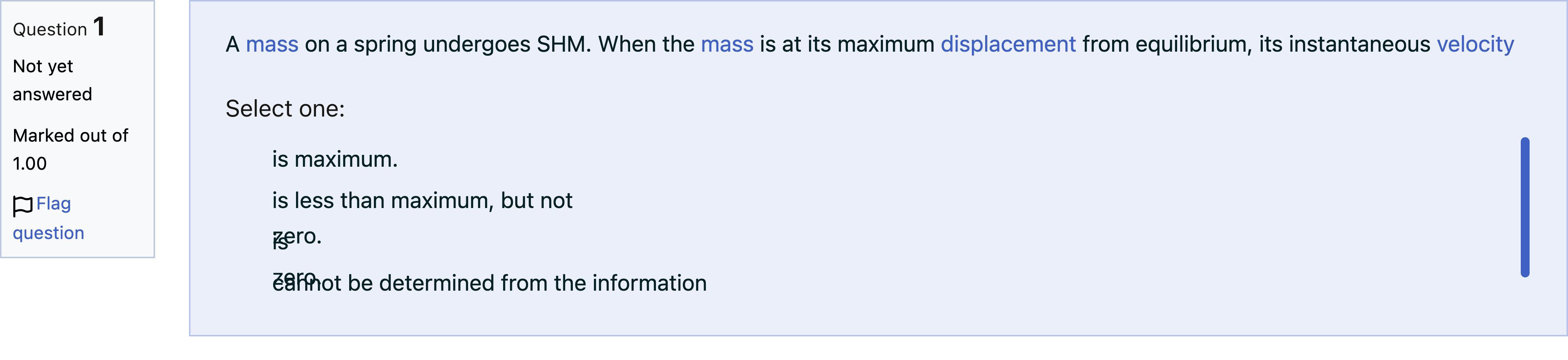
A mass on a spring undergoes SHM. When the mass is at its maximum displacement from equilibrium, its instantaneous velocitySingle choice
A
is maximum.
B
is less than maximum, but not zero.
C
is zero.
D
cannot be determined from the information given.
Log in for full answers
We've collected over 50,000 authentic original questions and detailed explanations from around the globe. Log in now and get instant access to the answers!
Similar Questions
A mass oscillates on the end of a spring. The motion of the mass is described by the equation: . Where is the frequency of the oscillations, is the spring constant of the spring and is the mass hanging on the spring. The period of the spring is measured for a number of different masses. The period is related to the frequency of oscillations through the relationship: . A student is trying to determine the spring constant, , of the spring. In order to do this they plan to plot a graph. Which of the following statements about this graph are correct?
A 0.50 kg mass is attached to a spring of spring constant 20 N/m along a horizontal, frictionless surface. The object oscillates in simple harmonic motion and has a speed of 1.5 m/s at the equilibrium position. At what location are the kinetic energy and the potential energy the same?
A 0.30 kg mass is suspended on a spring. In equilibrium the mass stretches the spring 2.0 cm downward. The mass is then pulled an additional distance of 1.0 cm down and released from rest. Calculate the period of oscillation.
A 4.0 kg object is attached to a spring of spring constant 10 N/m. The object is displaced by 5.0 cm from the equilibrium position and let go. What is the period of vibration?
More Practical Tools for Students Powered by AI Study Helper
Making Your Study Simpler
Join us and instantly unlock extensive past papers & exclusive solutions to get a head start on your studies!