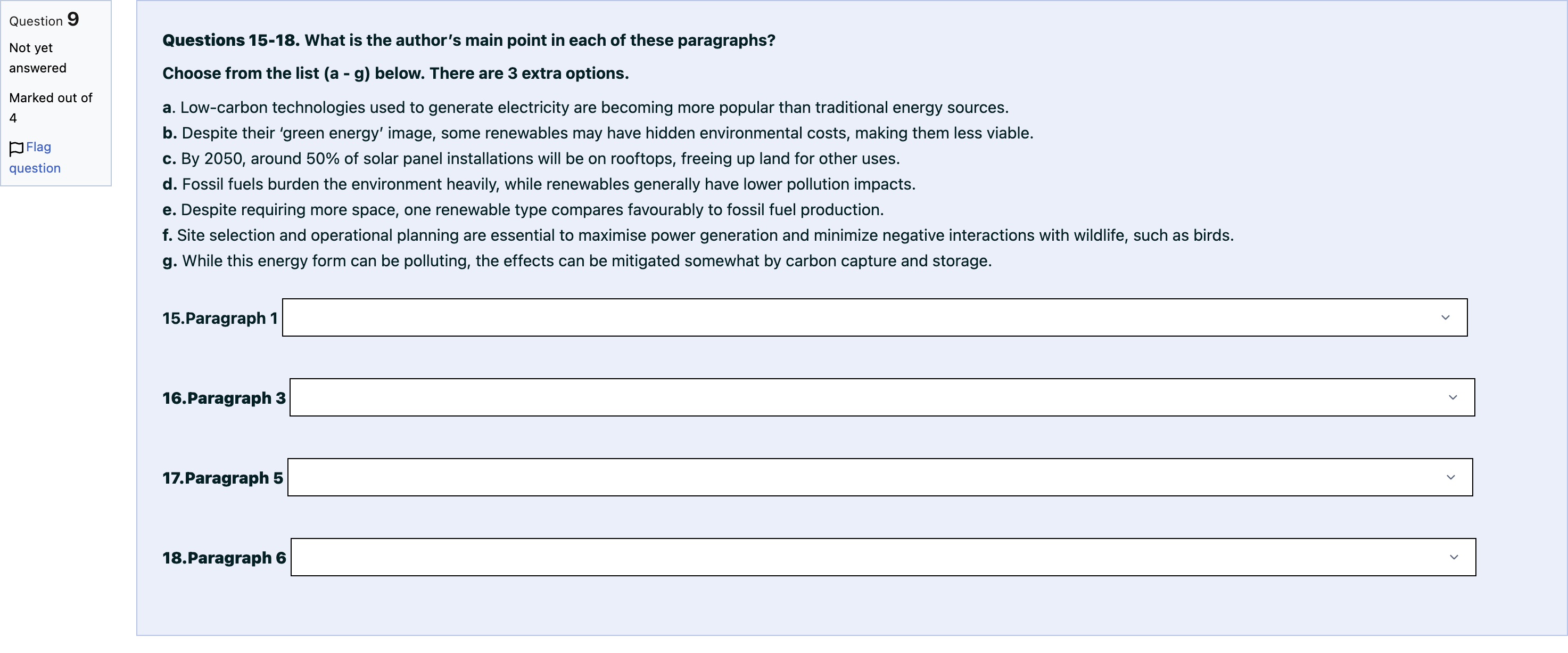
Question textQuestions 15-18. What is the author’s main point in each of these paragraphs? Choose from the list (a - g) below. There are 3 extra options.a. Low-carbon technologies used to generate electricity are becoming more popular than traditional energy sources.b. Despite their ‘green energy’ image, some renewables may have hidden environmental costs, making them less viable.c. By 2050, around 50% of solar panel installations will be on rooftops, freeing up land for other uses.d. Fossil fuels burden the environment heavily, while renewables generally have lower pollution impacts.e. Despite requiring more space, one renewable type compares favourably to fossil fuel production.f. Site selection and operational planning are essential to maximise power generation and minimize negative interactions with wildlife, such as birds.g. While this energy form can be polluting, the effects can be mitigated somewhat by carbon capture and storage.15.Paragraph 1 Answer 1 Question 9[select: , a. Low-carbon technologies used to generate electricity are becoming more popular than traditional energy sources., b. Despite their ‘green energy’ image, some renewables may have hidden environmental costs, making them less viable., c. By 2050, around 50% of solar panel installations will be on rooftops, freeing up land for other uses., d. Fossil fuels burden the environment heavily, while renewables generally have lower pollution impacts., e. Despite requiring more space, one renewable type compares favourably to fossil fuel production., f. Site selection and operational planning are essential to maximise power generation and minimize negative interactions with wildlife, such as birds., g. While this energy form can be polluting, the effects can be mitigated somewhat by carbon capture and storage.] 16.Paragraph 3 Answer 2 Question 9[select: , a. Low-carbon technologies used to generate electricity are becoming more popular than traditional energy sources., b. Despite their ‘green energy’ image, some renewables may have hidden environmental costs, making them less viable., c. By 2050, around 50% of solar panel installations will be on rooftops, freeing up land for other uses., d. Fossil fuels burden the environment heavily, while renewables generally have lower pollution impacts., e. Despite requiring more space, one renewable type compares favourably to fossil fuel production., f. Site selection and operational planning are essential to maximise power generation and minimize negative interactions with wildlife, such as birds., g. While this energy form can be polluting, the effects can be mitigated somewhat by carbon capture and storage.] 17.Paragraph 5 Answer 3 Question 9[select: , a. Low-carbon technologies used to generate electricity are becoming more popular than traditional energy sources., b. Despite their ‘green energy’ image, some renewables may have hidden environmental costs, making them less viable., c. By 2050, around 50% of solar panel installations will be on rooftops, freeing up land for other uses., d. Fossil fuels burden the environment heavily, while renewables generally have lower pollution impacts., e. Despite requiring more space, one renewable type compares favourably to fossil fuel production., f. Site selection and operational planning are essential to maximise power generation and minimize negative interactions with wildlife, such as birds., g. While this energy form can be polluting, the effects can be mitigated somewhat by carbon capture and storage.] 18.Paragraph 6 Answer 4 Question 9[select: , a. Low-carbon technologies used to generate electricity are becoming more popular than traditional energy sources., b. Despite their ‘green energy’ image, some renewables may have hidden environmental costs, making them less viable., c. By 2050, around 50% of solar panel installations will be on rooftops, freeing up land for other uses., d. Fossil fuels burden the environment heavily, while renewables generally have lower pollution impacts., e. Despite requiring more space, one renewable type compares favourably to fossil fuel production., f. Site selection and operational planning are essential to maximise power generation and minimize negative interactions with wildlife, such as birds., g. While this energy form can be polluting, the effects can be mitigated somewhat by carbon capture and storage.]Multiple fill-in-the-blank
Log in for full answers
We've collected over 50,000 authentic original questions and detailed explanations from around the globe. Log in now and get instant access to the answers!
Similar Questions
Question textQuestions 15-18. What is the author’s main point in each of these paragraphs? Choose from the list (a - g) below. There are 3 extra options.a. Low-carbon technologies used to generate electricity are becoming more popular than traditional energy sources.b. Despite their ‘green energy’ image, some renewables may have hidden environmental costs, making them less viable.c. By 2050, around 50% of solar panel installations will be on rooftops, freeing up land for other uses.d. Fossil fuels burden the environment heavily, while renewables generally have lower pollution impacts.e. Despite requiring more space, one renewable type compares favourably to fossil fuel production.f. Site selection and operational planning are essential to maximise power generation and minimize negative interactions with wildlife, such as birds.g. While this energy form can be polluting, the effects can be mitigated somewhat by carbon capture and storage.15.Paragraph 1 Answer 1 Question 9[select: , a. Low-carbon technologies used to generate electricity are becoming more popular than traditional energy sources., b. Despite their ‘green energy’ image, some renewables may have hidden environmental costs, making them less viable., c. By 2050, around 50% of solar panel installations will be on rooftops, freeing up land for other uses., d. Fossil fuels burden the environment heavily, while renewables generally have lower pollution impacts., e. Despite requiring more space, one renewable type compares favourably to fossil fuel production., f. Site selection and operational planning are essential to maximise power generation and minimize negative interactions with wildlife, such as birds., g. While this energy form can be polluting, the effects can be mitigated somewhat by carbon capture and storage.] 16.Paragraph 3 Answer 2 Question 9[select: , a. Low-carbon technologies used to generate electricity are becoming more popular than traditional energy sources., b. Despite their ‘green energy’ image, some renewables may have hidden environmental costs, making them less viable., c. By 2050, around 50% of solar panel installations will be on rooftops, freeing up land for other uses., d. Fossil fuels burden the environment heavily, while renewables generally have lower pollution impacts., e. Despite requiring more space, one renewable type compares favourably to fossil fuel production., f. Site selection and operational planning are essential to maximise power generation and minimize negative interactions with wildlife, such as birds., g. While this energy form can be polluting, the effects can be mitigated somewhat by carbon capture and storage.] 17.Paragraph 5 Answer 3 Question 9[select: , a. Low-carbon technologies used to generate electricity are becoming more popular than traditional energy sources., b. Despite their ‘green energy’ image, some renewables may have hidden environmental costs, making them less viable., c. By 2050, around 50% of solar panel installations will be on rooftops, freeing up land for other uses., d. Fossil fuels burden the environment heavily, while renewables generally have lower pollution impacts., e. Despite requiring more space, one renewable type compares favourably to fossil fuel production., f. Site selection and operational planning are essential to maximise power generation and minimize negative interactions with wildlife, such as birds., g. While this energy form can be polluting, the effects can be mitigated somewhat by carbon capture and storage.] 18.Paragraph 6 Answer 4 Question 9[select: , a. Low-carbon technologies used to generate electricity are becoming more popular than traditional energy sources., b. Despite their ‘green energy’ image, some renewables may have hidden environmental costs, making them less viable., c. By 2050, around 50% of solar panel installations will be on rooftops, freeing up land for other uses., d. Fossil fuels burden the environment heavily, while renewables generally have lower pollution impacts., e. Despite requiring more space, one renewable type compares favourably to fossil fuel production., f. Site selection and operational planning are essential to maximise power generation and minimize negative interactions with wildlife, such as birds., g. While this energy form can be polluting, the effects can be mitigated somewhat by carbon capture and storage.]
Question textQuestions 15-18. What is the author’s main point in each of these paragraphs? Choose from the list (a - g) below. There are 3 extra options.a. Low-carbon technologies used to generate electricity are becoming more popular than traditional energy sources.b. Despite their ‘green energy’ image, some renewables may have hidden environmental costs, making them less viable.c. By 2050, around 50% of solar panel installations will be on rooftops, freeing up land for other uses.d. Fossil fuels burden the environment heavily, while renewables generally have lower pollution impacts.e. Despite requiring more space, one renewable type compares favourably to fossil fuel production.f. Site selection and operational planning are essential to maximise power generation and minimize negative interactions with wildlife, such as birds.g. While this energy form can be polluting, the effects can be mitigated somewhat by carbon capture and storage.15.Paragraph 1 Answer 1 Question 9[select: , a. Low-carbon technologies used to generate electricity are becoming more popular than traditional energy sources., b. Despite their ‘green energy’ image, some renewables may have hidden environmental costs, making them less viable., c. By 2050, around 50% of solar panel installations will be on rooftops, freeing up land for other uses., d. Fossil fuels burden the environment heavily, while renewables generally have lower pollution impacts., e. Despite requiring more space, one renewable type compares favourably to fossil fuel production., f. Site selection and operational planning are essential to maximise power generation and minimize negative interactions with wildlife, such as birds., g. While this energy form can be polluting, the effects can be mitigated somewhat by carbon capture and storage.] 16.Paragraph 3 Answer 2 Question 9[select: , a. Low-carbon technologies used to generate electricity are becoming more popular than traditional energy sources., b. Despite their ‘green energy’ image, some renewables may have hidden environmental costs, making them less viable., c. By 2050, around 50% of solar panel installations will be on rooftops, freeing up land for other uses., d. Fossil fuels burden the environment heavily, while renewables generally have lower pollution impacts., e. Despite requiring more space, one renewable type compares favourably to fossil fuel production., f. Site selection and operational planning are essential to maximise power generation and minimize negative interactions with wildlife, such as birds., g. While this energy form can be polluting, the effects can be mitigated somewhat by carbon capture and storage.] 17.Paragraph 5 Answer 3 Question 9[select: , a. Low-carbon technologies used to generate electricity are becoming more popular than traditional energy sources., b. Despite their ‘green energy’ image, some renewables may have hidden environmental costs, making them less viable., c. By 2050, around 50% of solar panel installations will be on rooftops, freeing up land for other uses., d. Fossil fuels burden the environment heavily, while renewables generally have lower pollution impacts., e. Despite requiring more space, one renewable type compares favourably to fossil fuel production., f. Site selection and operational planning are essential to maximise power generation and minimize negative interactions with wildlife, such as birds., g. While this energy form can be polluting, the effects can be mitigated somewhat by carbon capture and storage.] 18.Paragraph 6 Answer 4 Question 9[select: , a. Low-carbon technologies used to generate electricity are becoming more popular than traditional energy sources., b. Despite their ‘green energy’ image, some renewables may have hidden environmental costs, making them less viable., c. By 2050, around 50% of solar panel installations will be on rooftops, freeing up land for other uses., d. Fossil fuels burden the environment heavily, while renewables generally have lower pollution impacts., e. Despite requiring more space, one renewable type compares favourably to fossil fuel production., f. Site selection and operational planning are essential to maximise power generation and minimize negative interactions with wildlife, such as birds., g. While this energy form can be polluting, the effects can be mitigated somewhat by carbon capture and storage.]
3. The speaker seems most disappointed about:
2. A typical flying car costs about Answer Question 2[input] times more than a regular car.
More Practical Tools for Students Powered by AI Study Helper
Making Your Study Simpler
Join us and instantly unlock extensive past papers & exclusive solutions to get a head start on your studies!