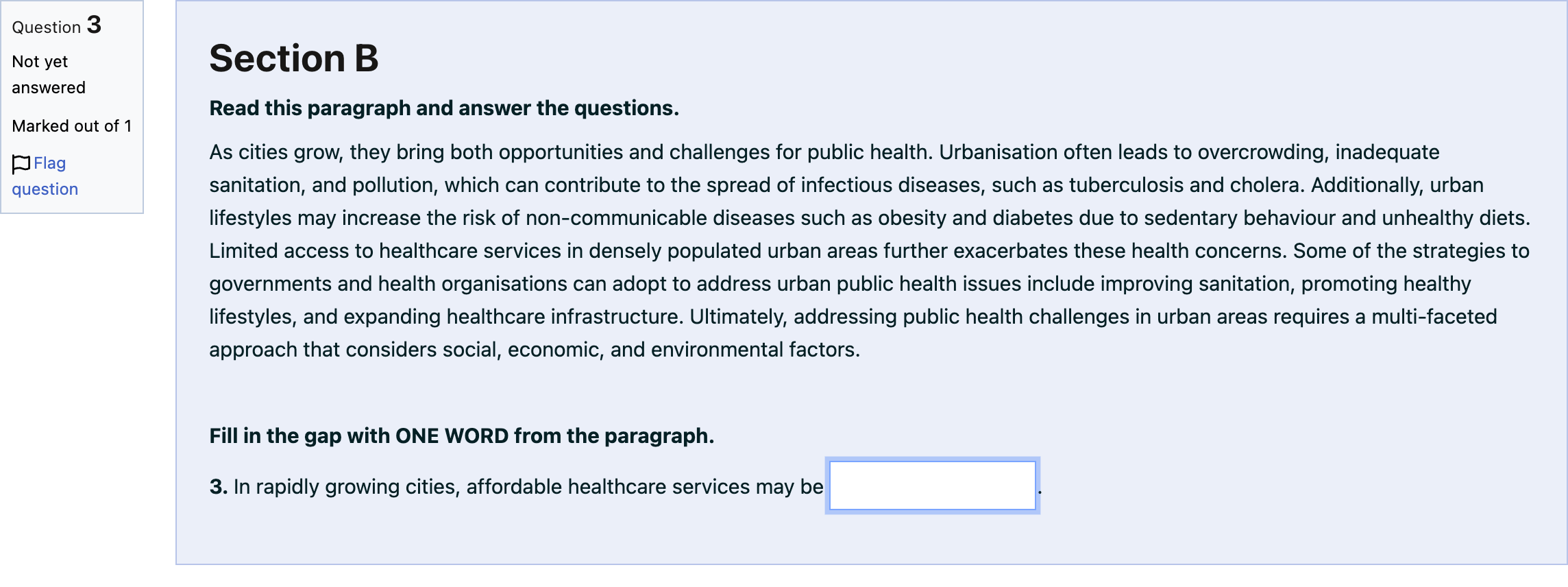
Section BRead this paragraph and answer the questions. As cities grow, they bring both opportunities and challenges for public health. Urbanisation often leads to overcrowding, inadequate sanitation, and pollution, which can contribute to the spread of infectious diseases, such as tuberculosis and cholera. Additionally, urban lifestyles may increase the risk of non-communicable diseases such as obesity and diabetes due to sedentary behaviour and unhealthy diets. Limited access to healthcare services in densely populated urban areas further exacerbates these health concerns. Some of the strategies to governments and health organisations can adopt to address urban public health issues include improving sanitation, promoting healthy lifestyles, and expanding healthcare infrastructure. Ultimately, addressing public health challenges in urban areas requires a multi-faceted approach that considers social, economic, and environmental factors. Fill in the gap with ONE WORD from the paragraph.3. In rapidly growing cities, affordable healthcare services may be Answer Question 3[input].Short answer
Log in for full answers
We've collected over 50,000 authentic original questions and detailed explanations from around the globe. Log in now and get instant access to the answers!
Similar Questions
30. What is the main purpose of the lecture?
Choose A, B or C as the best answer.3. The speaker seems most concerned about:
Question textQuestions 25 – 29. Complete this summary of the last two paragraphs of the text by filling in each blank with ONE WORD from the text.Digital transformation is revolutionising all sectors of the economy, including 25. Answer 1 Question 13[input] . As a result of this evolution, information management will 26. Answer 2 Question 13[input] central to the relationship between farmers and service providers. Improved access to information will shift the power dynamics within the industry, diminishing the advantage of local knowledge. Embracing digital technologies presents a crucial 27. Answer 3 Question 13[input] for addressing global challenges in food, water, energy, and climate change. As a key player in international commodity markets, Australia must not overlook these 28. Answer 4 Question 13[input]. Continued 29. Answer 5 Question 13[input] for agricultural innovation is imperative for progress.
11. Which of the following statements best summarises the main idea of this paragraph?
More Practical Tools for Students Powered by AI Study Helper
Making Your Study Simpler
Join us and instantly unlock extensive past papers & exclusive solutions to get a head start on your studies!