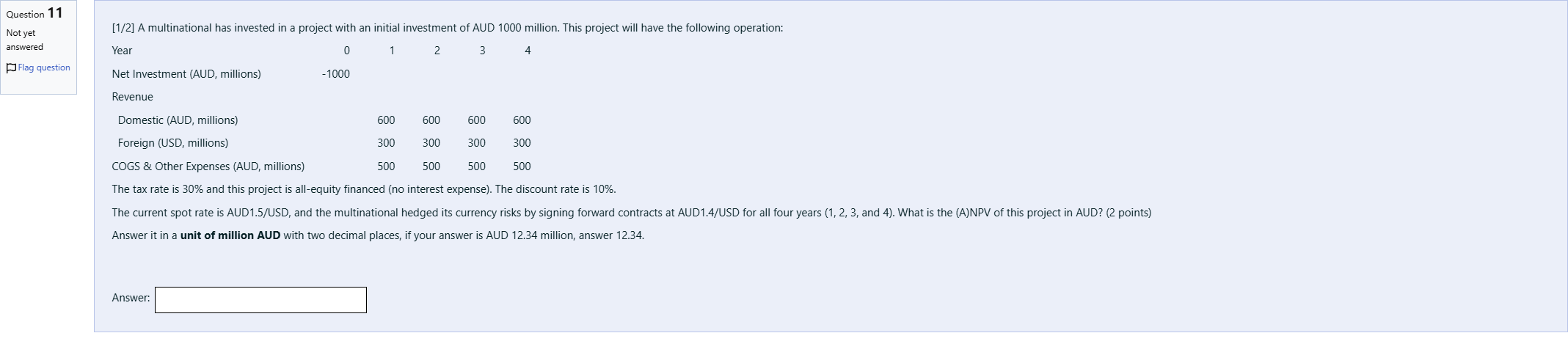
[1/2] A multinational has invested in a project with an initial investment of AUD 1000 million. This project will have the following operation: [table] Year | 0 | 1 | 2 | 3 | 4 Net Investment (AUD, millions) | -1000 | | | | Revenue | | | | | Domestic (AUD, millions) | | 600 | 600 | 600 | 600 Foreign (USD, millions) | | 300 | 300 | 300 | 300 COGS & Other Expenses (AUD, millions) | | 500 | 500 | 500 | 500 [/table] The tax rate is 30% and this project is all-equity financed (no interest expense). The discount rate is 10%. The current spot rate is AUD1.5/USD, and the multinational hedged its currency risks by signing forward contracts at AUD1.4/USD for all four years (1, 2, 3, and 4). What is the (A)NPV of this project in AUD? (2 points) Answer it in a unit of million AUD with two decimal places, if your answer is AUD 12.34 million, answer 12.34.Numerical
Log in for full answers
We've collected over 50,000 authentic original questions and detailed explanations from around the globe. Log in now and get instant access to the answers!
Similar Questions
Luther Industries just invented a new mobile phone. Luther Industries will need one year to develop pilot products and test marketing, which will cost Luther Industries $200,000 immediately. The probability of market demand being high is 40%, and the probability of market demand being low is 60%. If the market demand is high, Luther Industries will invest $2,600,000 at the end of Year One, and expect to receive after-tax cash flow of $300,000 in perpetuity beginning in Year Two. But if market demand is low, Luther Industries will invest $1,500,000 at the end of Year One, generating $180,000 in perpetuity beginning in Year Two. The cost of capital for this project is assumed to be 10% per annum. The NPV of the new project for Luther Industries is closest to:[Fill in the blank]
Crestfield Industries, a German company, is considering a new project in Japan. Meanwhile, the following expected free cash flows measured in Japanese yen are assumed to be uncorrelated with the spot exchange rate. Suppose the Euro WACC of 8% is appropriate to evaluate this project. The risk-free interest rates on Euros and yen are 7% and 5%, respectively. [table] Year | FCF (¥ millions) 0 | -90 1 | 40 2 | 50 3 | 55 4 | 45 [/table] If capital markets are internationally integrated, the NPV of this project in Japanese yens is closest to:[Fill in the blank]
When using the NPV method for a particular investsment decision, if the present value of all cash inflows is greater than the present value of all cash outflows, then ________.
TexMex Food Company is considering a new salsa whose data are shown below. There is a new tax law which is replacing straight-line depreciation. Under this new tax law, the equipment (CapEx) to be used in the project is eligible for 100% immediate depreciation, so it will be fully depreciated at t = 0. At the end of the project’s life, the equipment would have zero salvage value, and no change in net working capital (NWC) would be required for the project. Revenues and operating costs are expected to be constant over the project's 3-year life. However, this project would compete with other TexMex products and would reduce their pre-tax annual cash flows. What is the project's NPV? (Hint: Cash flows are constant in Years 1-3.) Do not round the intermediate calculations and round the final answer to the nearest whole number. WACC 10.0% Pre-tax cash flow reduction for other products (cannibalization) -$5,000 Equipment cost $80,000 Annual sales revenues $55,000 Annual operating costs -$25,000 Tax rate 25.0%
More Practical Tools for Students Powered by AI Study Helper
Making Your Study Simpler
Join us and instantly unlock extensive past papers & exclusive solutions to get a head start on your studies!