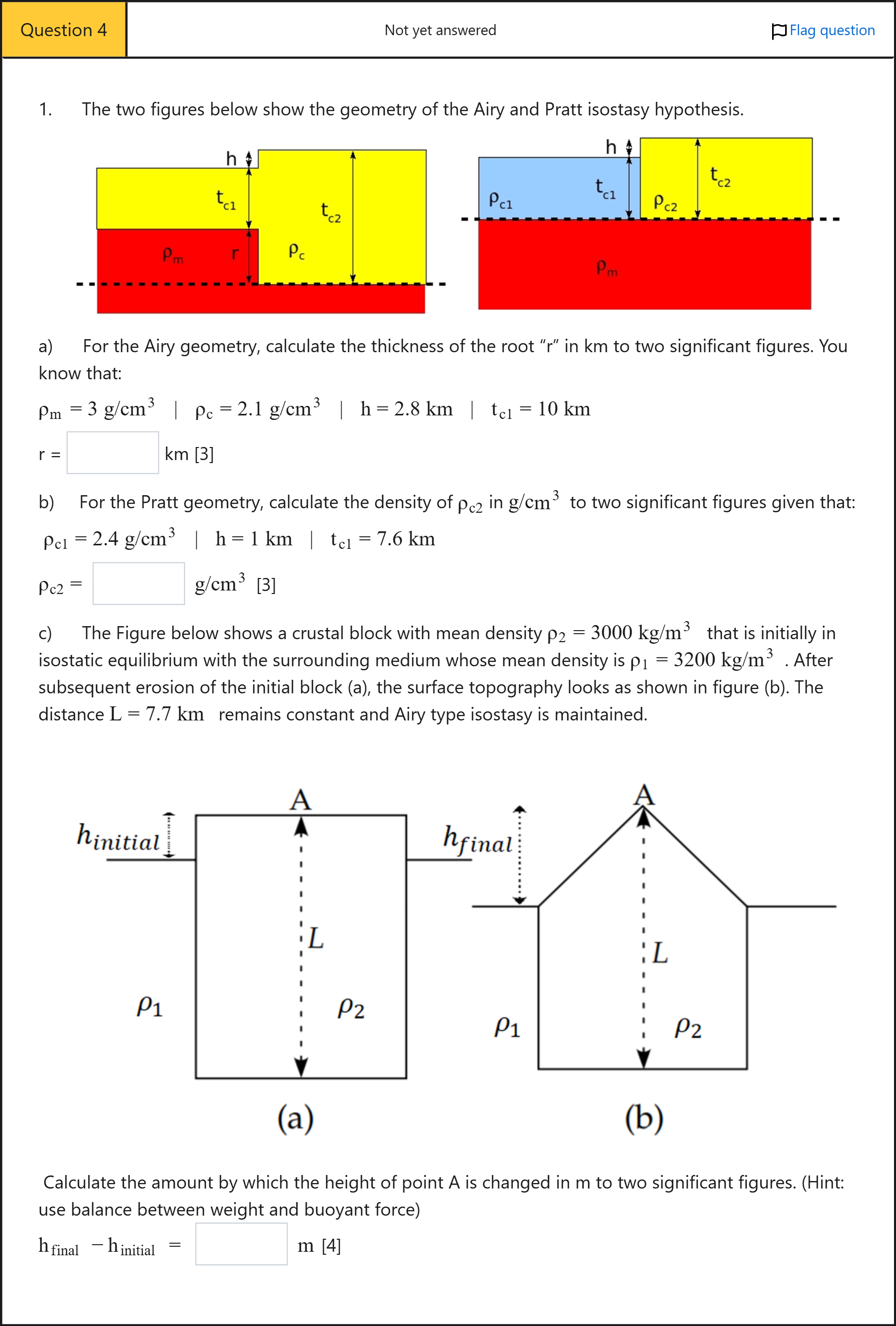
Question text1. The two figures below show the geometry of the Airy and Pratt isostasy hypothesis. a) For the Airy geometry, calculate the thickness of the root “r” in km to two significant figures. You know that: [math: ρm=3g/cm3|ρc=2.1g/cm3|h=2.8km|tc1=10km]r = Answer 1 Question 4[input] km [3] b) For the Pratt geometry, calculate the density of [math: ρc2] in [math: g/cm3] to two significant figures given that: [math: ρc1=2.4g/cm3|h=1km|tc1=7.6km][math: ρc2=] Answer 2 Question 4[input] [math: g/cm3] [3] c) The Figure below shows a crustal block with mean density [math: ρ2=3000kg/m3] that is initially in isostatic equilibrium with the surrounding medium whose mean density is [math: ρ1=3200kg/m3]. After subsequent erosion of the initial block (a), the surface topography looks as shown in figure (b). The distance [math: L=7.7km] remains constant and Airy type isostasy is maintained. Calculate the amount by which the height of point A is changed in m to two significant figures. (Hint: use balance between weight and buoyant force)[math: hfinal−hinitial=] Answer 3 Question 4[input] [math: m] [4]Multiple fill-in-the-blank
Log in for full answers
We've collected over 50,000 authentic original questions and detailed explanations from around the globe. Log in now and get instant access to the answers!
Similar Questions
The principles of buoyancy and balance, when applied to Earth's crust, helps us to explain fluctuations in Earth's outer crust, a property known as
The concept that the earth's crust floats so that when a load is removed it rises to a new equilibrium is known as __________. An example of this process is when glaciers melt (removing mass from the crust) and the land rises to adjust. The parallel beach ridges in this image are evidence of this process.
Isostasy, the condition of equilibrium between floating landmasses and the denser rock beneath them, can best be explained by:
Is the following statement true or false? In the products of methylation-hydrolysis, every -OH group corresponds to the position of a glycosidic bond in the starting polysaccharide.
More Practical Tools for Students Powered by AI Study Helper
Making Your Study Simpler
Join us and instantly unlock extensive past papers & exclusive solutions to get a head start on your studies!