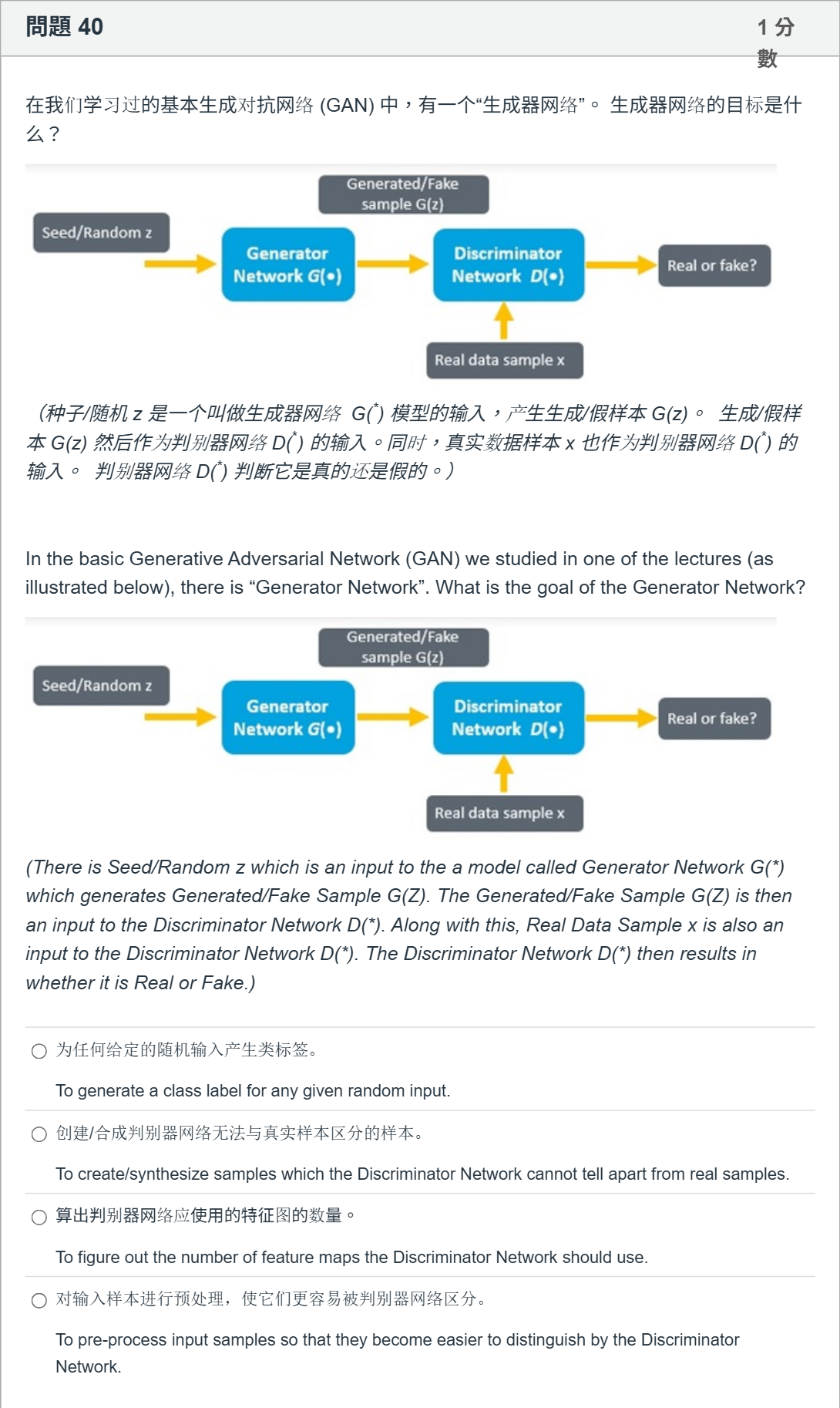
在我们学习过的基本生成对抗网络 (GAN) 中,有一个“生成器网络”。 生成器网络的目标是什么? (种子/随机 z 是一个叫做生成器网络 G(*) 模型的输入,产生生成/假样本 G(z)。 生成/假样本 G(z) 然后作为判别器网络 D(*) 的输入。同时,真实数据样本 x 也作为判别器网络 D(*) 的输入。 判别器网络 D(*) 判断它是真的还是假的。) In the basic Generative Adversarial Network (GAN) we studied in one of the lectures (as illustrated below), there is “Generator Network”. What is the goal of the Generator Network? (There is Seed/Random z which is an input to the a model called Generator Network G(*) which generates Generated/Fake Sample G(Z). The Generated/Fake Sample G(Z) is then an input to the Discriminator Network D(*). Along with this, Real Data Sample x is also an input to the Discriminator Network D(*). The Discriminator Network D(*) then results in whether it is Real or Fake.)Single choice
A
为任何给定的随机输入产生类标签。 To generate a class label for any given random input.
B
创建/合成判别器网络无法与真实样本区分的样本。 To create/synthesize samples which the Discriminator Network cannot tell apart from real samples.
C
算出判别器网络应使用的特征图的数量。 To figure out the number of feature maps the Discriminator Network should use.
D
对输入样本进行预处理,使它们更容易被判别器网络区分。 To pre-process input samples so that they become easier to distinguish by the Discriminator Network.
Log in for full answers
We've collected over 50,000 authentic original questions and detailed explanations from around the globe. Log in now and get instant access to the answers!
Similar Questions
Which statement about Generative Adversarial Networks (GANs) is TRUE?
Reference Figure 1. Typically early in training, the value of D(G(z)) is closer to which of the following values?
Reference Figure 1. You know that your GAN is trained when D(G(z)) is close to 1
Reference Figure 1. Two cost functions are presented in the figure, which one would you use to train your GAN?
More Practical Tools for Students Powered by AI Study Helper
Making Your Study Simpler
Join us and instantly unlock extensive past papers & exclusive solutions to get a head start on your studies!