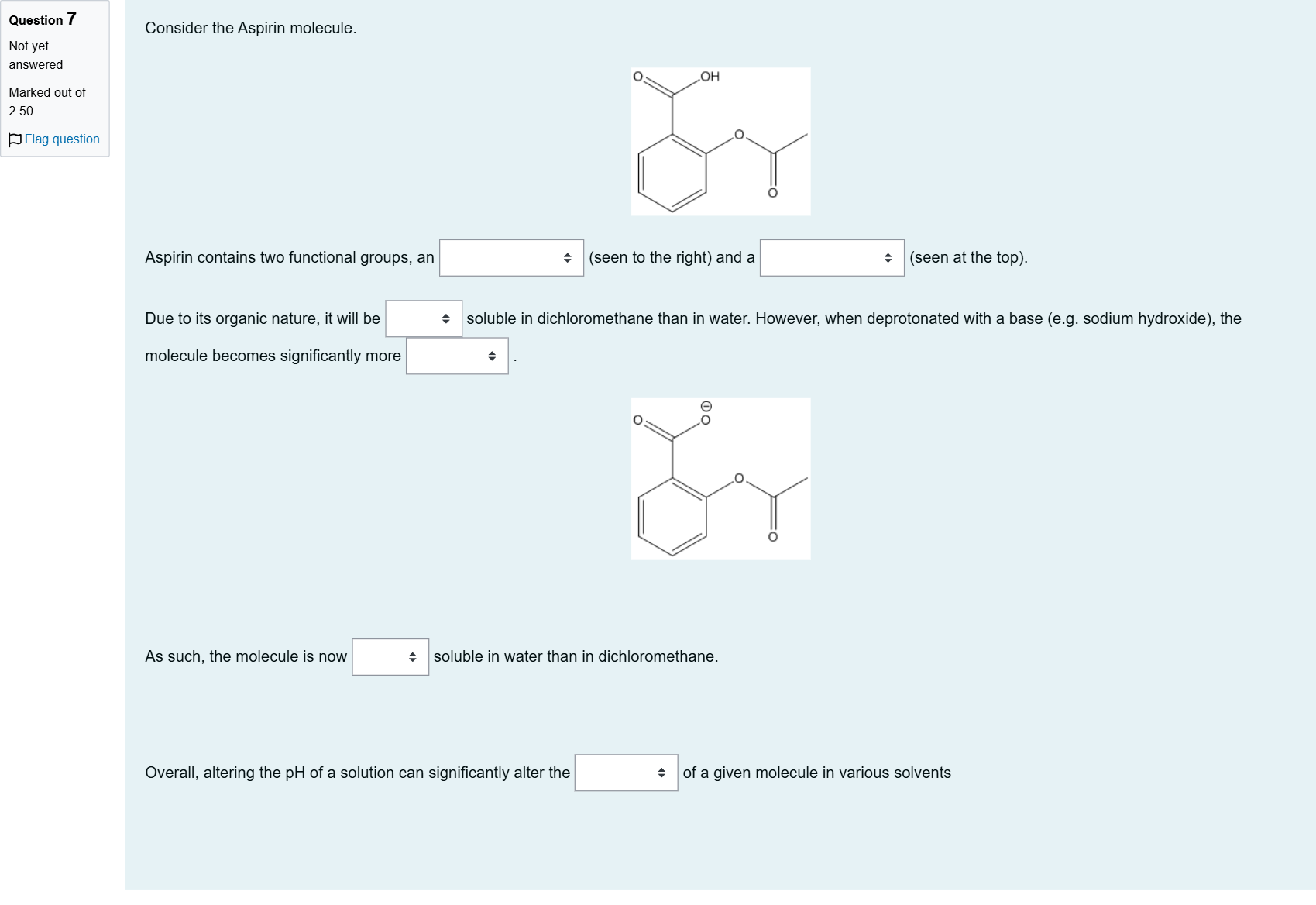
Consider the Aspirin molecule. Aspirin contains two functional groups, an Blank 1 Question 7[select: , ester, carboxylic acid] (seen to the right) and a Blank 2 Question 7[select: , ester, carboxylic acid] (seen at the top). Due to its organic nature, it will be Blank 3 Question 7[select: , more, less] soluble in dichloromethane than in water. However, when deprotonated with a base (e.g. sodium hydroxide), the molecule becomes significantly more Blank 4 Question 7[select: , polar, nonpolar] . As such, the molecule is now Blank 5 Question 7[select: , more, less] soluble in water than in dichloromethane. Overall, altering the pH of a solution can significantly alter the Blank 6 Question 7[select: , solubility, density] of a given molecule in various solventsMultiple dropdown selections
Log in for full answers
We've collected over 50,000 authentic original questions and detailed explanations from around the globe. Log in now and get instant access to the answers!
Similar Questions
Consider the following molecule. The functional group(s) present in the molecule above are: aldehyde and ether
In this molecule four different functional groups are circled. Which is the amine functional group?
Which of these sentences about structural alerts is false?
The functional groups present in the following molecule include A. a diketone B. an ester C. an anhydride D. a carboxylic acid
More Practical Tools for Students Powered by AI Study Helper
Making Your Study Simpler
Join us and instantly unlock extensive past papers & exclusive solutions to get a head start on your studies!