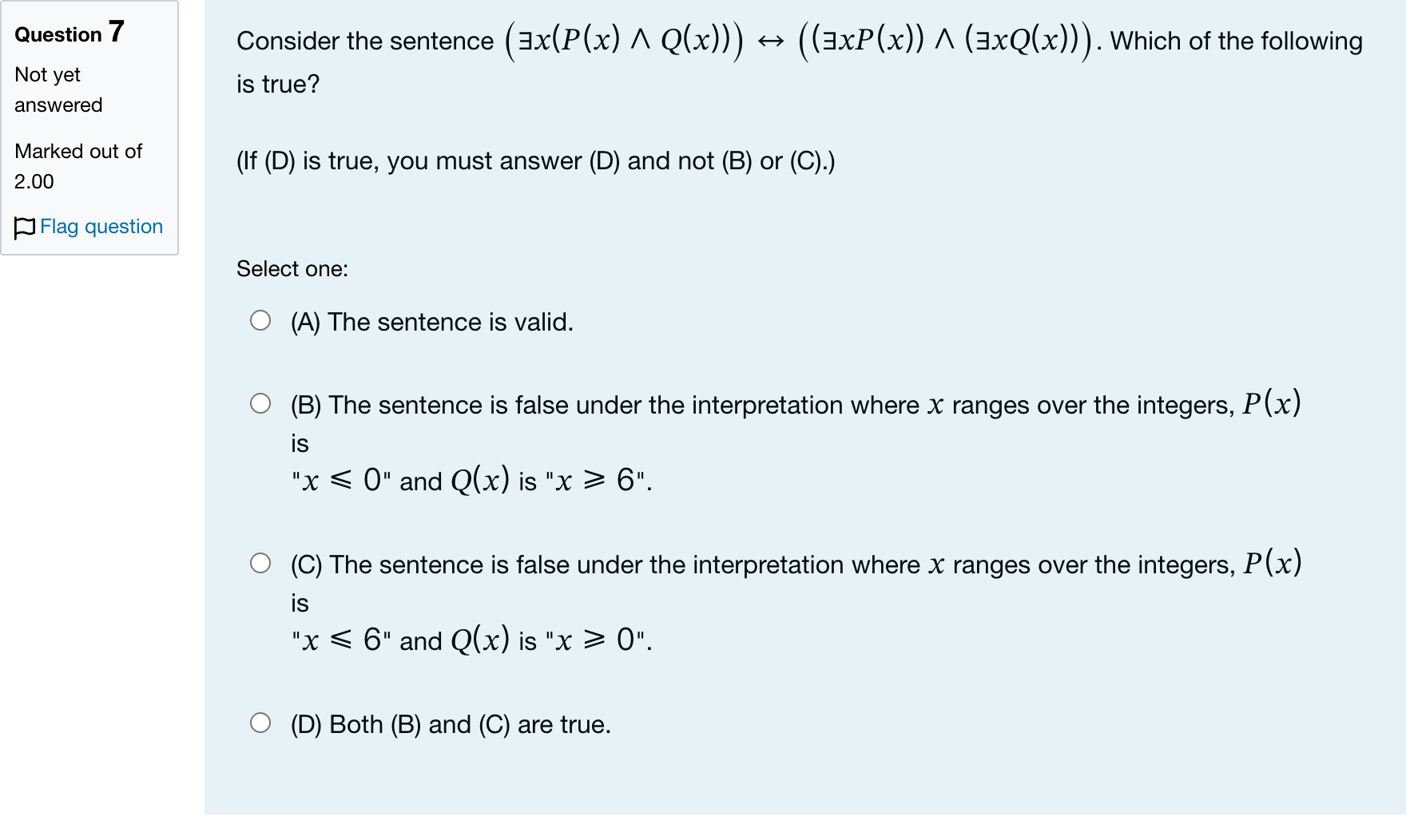
Consider the sentence [math: (∃x(P(x)∧Q(x)))↔((∃xP(x))∧(∃xQ(x)))]. Which of the following is true?(If (D) is true, you must answer (D) and not (B) or (C).)Single choice
A
(A) The sentence is valid.
B
(B) The sentence is false under the interpretation where [math: x] ranges over the integers, [math: P(x)] is"[math: x≤0]" and [math: Q(x)] is "[math: x≥6]".
C
(C) The sentence is false under the interpretation where [math: x] ranges over the integers, [math: P(x)] is"[math: x≤6]" and [math: Q(x)] is "[math: x≥0]".
D
(D) Both (B) and (C) are true.
Log in for full answers
We've collected over 50,000 authentic original questions and detailed explanations from around the globe. Log in now and get instant access to the answers!
Similar Questions
[math: ∀x(¬P(x)→Q(x))]
Select the most appropriate statement about each formula. 1: ∀x (T(x) ∨ ¬T(x)) 2: ∃x∀y (x ≠ y) 3: ∀x∀y (P(x,y) → P(y,x)) 4: ∀x (P(x,x))
Select the most appropriate statement about each formula. 1: ∀x∀y (x = y → y = x) 2: ∀x (¬(x = x)) 3: ∀x∀y (R(x,y) → ¬R(y,x)) 4: ∃x ∀y R(x,y)
Consider the universe of discourse 𝑈 = 𝑅 and binary relation 𝐿 = { ( 𝑎 , 𝑏 ) | 𝑎 , 𝑏 ∈ 𝑅 , 𝑎 < 𝑏 } . Which one of the following wffs is true in this model?
More Practical Tools for Students Powered by AI Study Helper
Making Your Study Simpler
Join us and instantly unlock extensive past papers & exclusive solutions to get a head start on your studies!