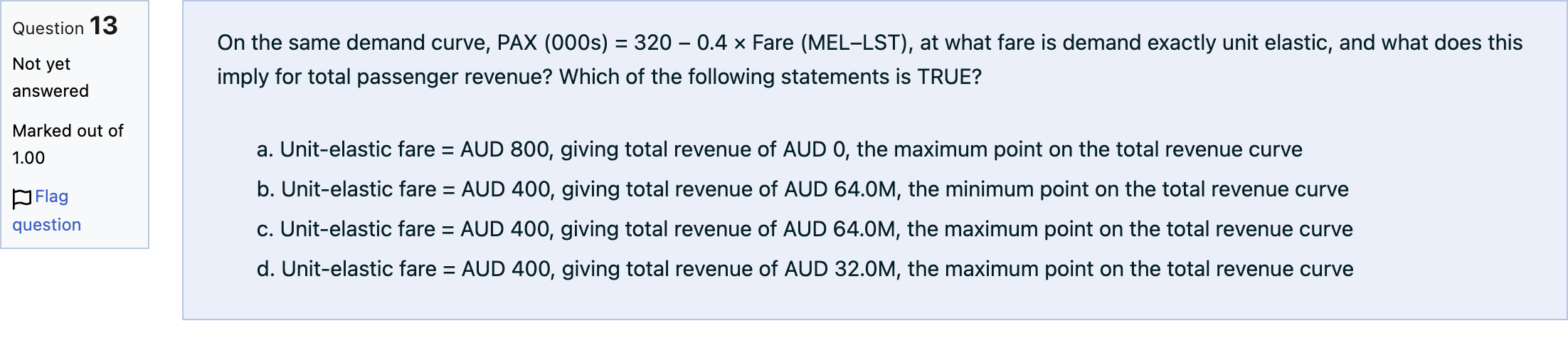
On the same demand curve, PAX (000s) = 320 − 0.4 × Fare (MEL–LST), at what fare is demand exactly unit elastic, and what does this imply for total passenger revenue? Which of the following statements is TRUE?Single choice
A
a. Unit-elastic fare = AUD 800, giving total revenue of AUD 0, the maximum point on the total revenue curve
B
b. Unit-elastic fare = AUD 400, giving total revenue of AUD 64.0M, the minimum point on the total revenue curve
C
c. Unit-elastic fare = AUD 400, giving total revenue of AUD 64.0M, the maximum point on the total revenue curve
D
d. Unit-elastic fare = AUD 400, giving total revenue of AUD 32.0M, the maximum point on the total revenue curve
Log in for full answers
We've collected over 50,000 authentic original questions and detailed explanations from around the globe. Log in now and get instant access to the answers!
Similar Questions
In the 1990s, Pandora had a price elasticity of demand for imports of 0.24 and a price elasticity of demand for exports of 0.56. A depreciation of the Pandora sol would: Check all correct answers Each choice is worth 0.5 points, which you will receive if you correctly either check or do not check the choice
Which country is most likely to have a ƐD for imports + ƐD for exports > 1?
Which is true regarding price elasticity of demand?
Which demand curve corresponds to a more competitive market?
More Practical Tools for Students Powered by AI Study Helper
Making Your Study Simpler
Join us and instantly unlock extensive past papers & exclusive solutions to get a head start on your studies!