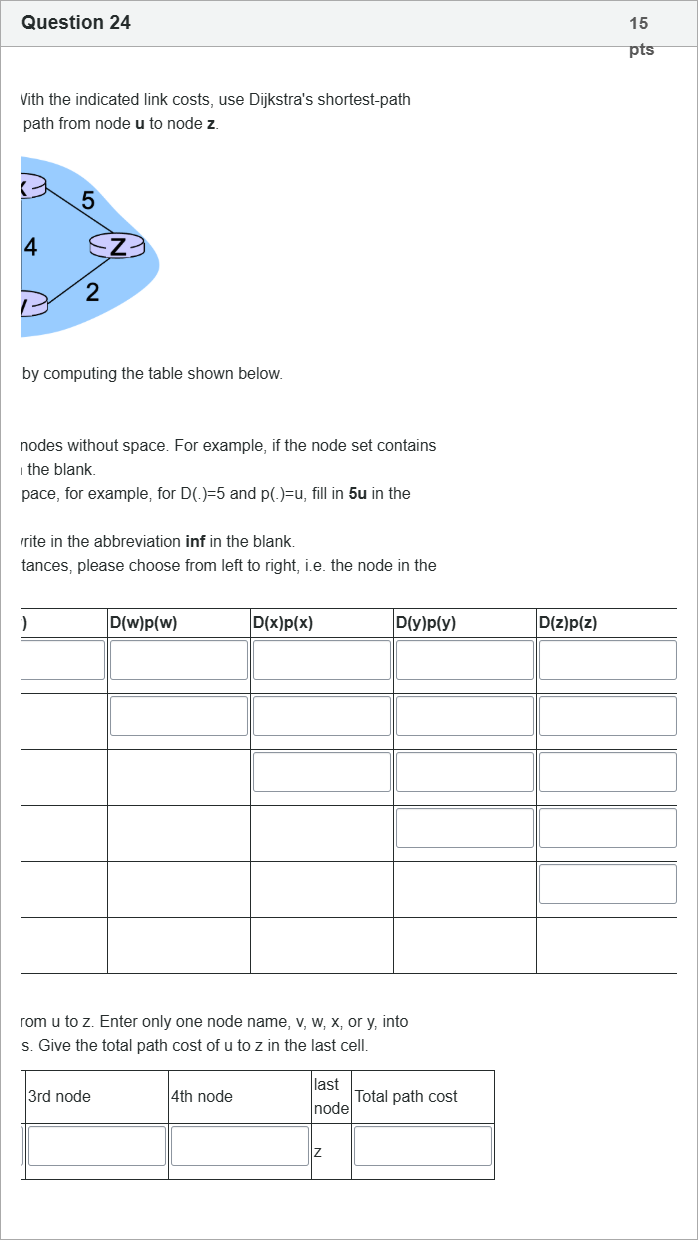
Consider the following network. With the indicated link costs, use Dijkstra's shortest-path algorithm to compute the shortest path from node u to node z. A. Show how the algorithm works by computing the table shown below. Note on answer format: Fill in the N* set with selected nodes without space. For example, if the node set contains nodes, x, y, and z, enter xyz in the blank. Fill in the D(.)p(.) cell without space, for example, for D(.)=5 and p(.)=u, fill in 5u in the blank. When the distance is infinity, write in the abbreviation inf in the blank. When there is a tie in node distances, please choose from left to right, i.e. the node in the left column is chosen first. Step N* D(v)p(v) D(w)p(w) D(x)p(x) D(y)p(y) D(z)p(z) 0 [Fill in the blank] [Fill in the blank] [Fill in the blank] [Fill in the blank] [Fill in the blank] [Fill in the blank] 1 [Fill in the blank] [Fill in the blank] [Fill in the blank] [Fill in the blank] [Fill in the blank] 2 [Fill in the blank] [Fill in the blank] [Fill in the blank] [Fill in the blank] 3 [Fill in the blank] [Fill in the blank] [Fill in the blank] 4 [Fill in the blank] [Fill in the blank] 5 [Fill in the blank] B. Enumerate the shortest paths from u to z. Enter only one node name, v, w, x, or y, into each of the intermediate node cells. Give the total path cost of u to z in the last cell. 1st node 2nd node 3rd node 4th node last node Total path cost u → z u [Fill in the blank] [Fill in the blank] [Fill in the blank] z [Fill in the blank] Multiple fill-in-the-blank
Log in for full answers
We've collected over 50,000 authentic original questions and detailed explanations from around the globe. Log in now and get instant access to the answers!
Similar Questions
What is the time complexity of Dijkstra's algorithm using a priority queue (min-heap) implemented with a binary heap?
Why is Dijkstra's algorithm not suitable for graphs with negative weight edges?
Question textApply Dijkstra's algorithm to find the shortest path from node 1 to all other nodes in the following directed graph. The numbers on the arcs represent costs , with data provided again below for completeness. Node 1: Node 2: Node 3: Node 4: Node 5: Node 6: Node 7: Node 8: Enter the shortest distance from node 1 to each node: Node 3: Answer 1 Question 3[input] predecessor = Answer 2 Question 3[input] Node 4: Answer 3 Question 3[input] Node 5: Answer 4 Question 3[input] If the problem of finding a shortest path from node 1 to node 3 was solved as a linear program with arc flow variables , then:The reduced cost of would be Answer 5 Question 3[input] If is the optimal value of the dual variables for the flow conservation constraints, then Answer 6 Question 3[input]
Dijkstra's Link State Algorithm Consider the incomplete 6-node network shown below, with given link costs; where links x and y are unknown Consider the completed table below, which calculates the shortest distance to all nodes from U: Nodes d, (p) d, (p) d, (p) d, (p) d, (p) U V W X Y Z shortest distance from node U 0 4, X 3, U 1, U 5, X 6, W For link x (link from node X, to node Y) , what is the cost associated with this link? [Fill in the blank] For link y (link from node U to node W) , what is the cost associated with this link?[Fill in the blank]
More Practical Tools for Students Powered by AI Study Helper
Making Your Study Simpler
Join us and instantly unlock extensive past papers & exclusive solutions to get a head start on your studies!