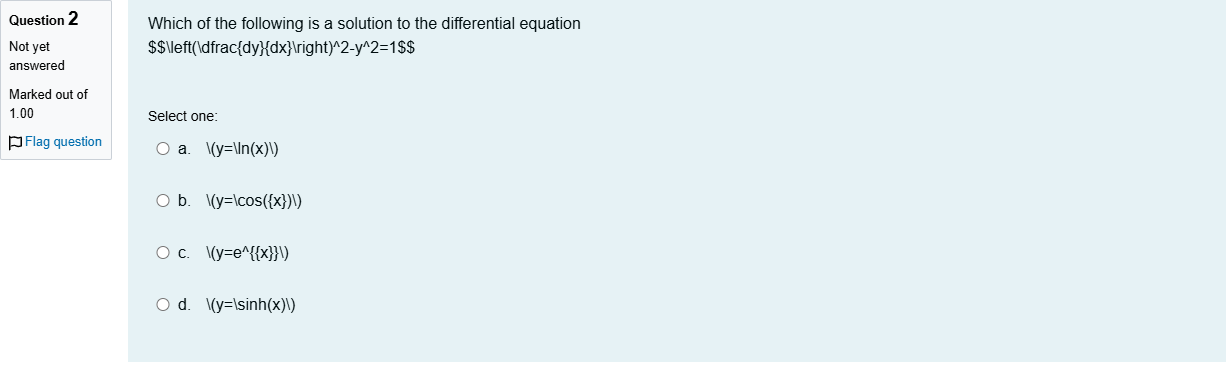
Which of the following is a solution to the differential equation$$\left(\dfrac{dy}{dx}\right)^2-y^2=1$$Single choice
A
a. \(y=\ln(x)\)
B
b. \(y=\cos({x})\)
C
c. \(y=e^{{x}}\)
D
d. \(y=\sinh(x)\)
Log in for full answers
We've collected over 50,000 authentic original questions and detailed explanations from around the globe. Log in now and get instant access to the answers!
Similar Questions
To solve the following ODE by a numerical method, you need to rewrite the equation as [math: 3dydx+5y2=sinx,y(0)=5]
Consider the system of ODEs \[\dfrac{dx}{dt} = x + y, \qquad \dfrac{dy}{dt} = y\] The general solution of this system of equations is
Question textFill in the missing terms in the statements below: Initial value problems consist of an ODE together with conditions imposed at Answer 1 Question 1[select: , one point, two points, every point], while boundary value problems consistent of an ODE together with conditions imposed at Answer 2 Question 1[select: , one point, two points, every point]. Linear, constant coefficient, homogeneous (with [math: r(x)=0]) IVPs Answer 3 Question 1[select: , never have solutions, always have a unique solution, always have infinitely many solutions, can have no solutions, a unique solution or infinitely many solutions]. Linear, constant coefficient, homogeneous (with [math: r(x)=0]) BVPs Answer 4 Question 1[select: , never have solutions, always have a unique solution, always have infinitely many solutions, can have no solutions, a unique solution or infinitely many solutions].
Consider the system of ODEs \[\dfrac{dx}{dt} = x + y, \qquad \dfrac{dy}{dt} = y\] The general solution of this system of equations is
More Practical Tools for Students Powered by AI Study Helper
Making Your Study Simpler
Join us and instantly unlock extensive past papers & exclusive solutions to get a head start on your studies!