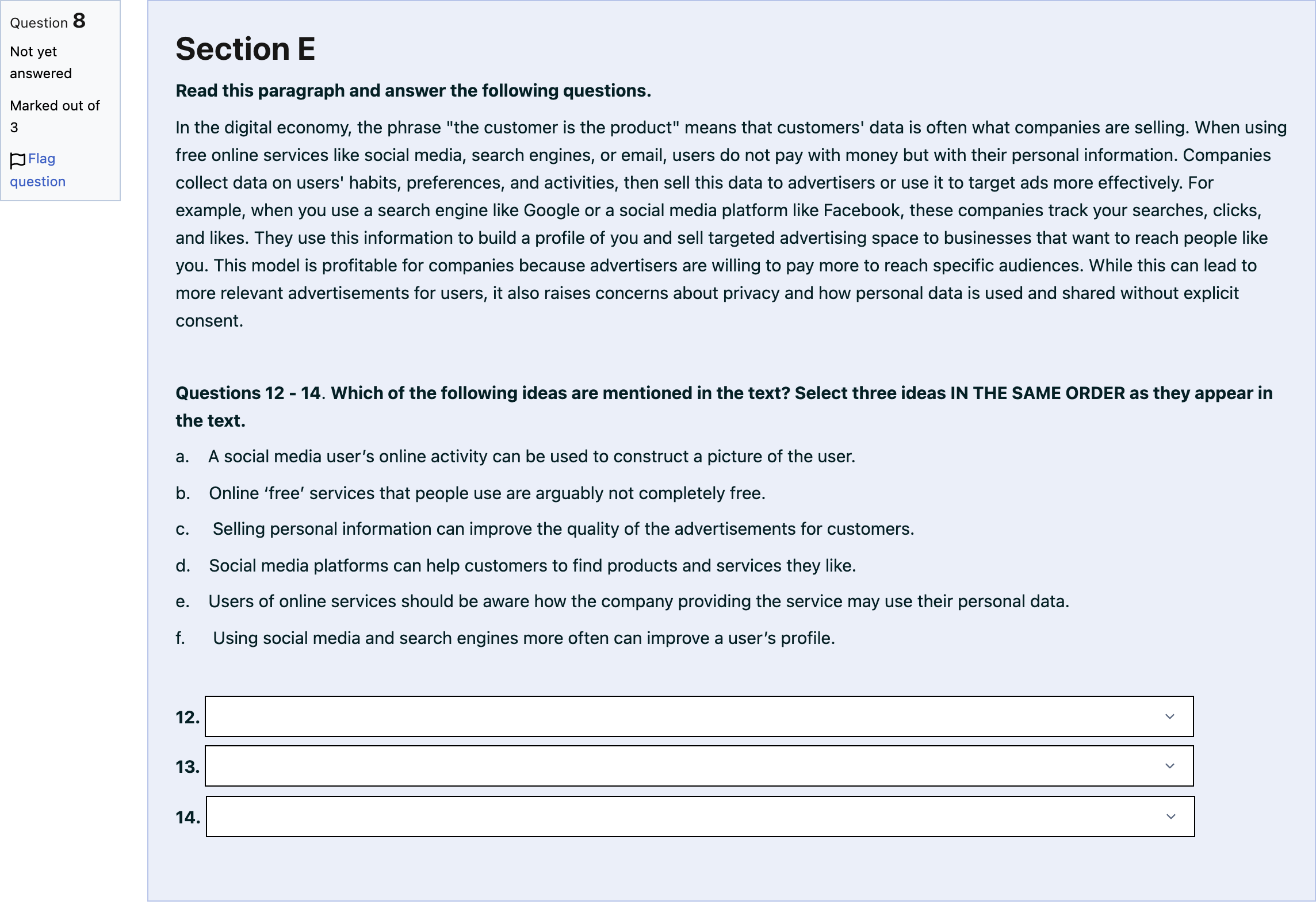
Question textSection E Read this paragraph and answer the following questions. In the digital economy, the phrase "the customer is the product" means that customers' data is often what companies are selling. When using free online services like social media, search engines, or email, users do not pay with money but with their personal information. Companies collect data on users' habits, preferences, and activities, then sell this data to advertisers or use it to target ads more effectively. For example, when you use a search engine like Google or a social media platform like Facebook, these companies track your searches, clicks, and likes. They use this information to build a profile of you and sell targeted advertising space to businesses that want to reach people like you. This model is profitable for companies because advertisers are willing to pay more to reach specific audiences. While this can lead to more relevant advertisements for users, it also raises concerns about privacy and how personal data is used and shared without explicit consent. Questions 12 - 14. Which of the following ideas are mentioned in the text? Select three ideas IN THE SAME ORDER as they appear in the text. a. A social media user’s online activity can be used to construct a picture of the user. b. Online ‘free’ services that people use are arguably not completely free. c. Selling personal information can improve the quality of the advertisements for customers. d. Social media platforms can help customers to find products and services they like. e. Users of online services should be aware how the company providing the service may use their personal data. f. Using social media and search engines more often can improve a user’s profile. 12. Answer 1 Question 8[select: , a. A social media user’s online activity can be used to construct a picture of the user., b. Online ‘free’ services that people use are arguably not completely free., c. Selling personal information can improve the quality of the advertisements for customers., d. Social media platforms can help customers to find products and services they like., e. Users of online services should be aware how the company providing the service may use their personal data., f. Using social media and search engines more often can improve a user’s profile.] 13. Answer 2 Question 8[select: , a. A social media user’s online activity can be used to construct a picture of the user., b. Online ‘free’ services that people use are arguably not completely free., c. Selling personal information can improve the quality of the advertisements for customers., d. Social media platforms can help customers to find products and services they like., e. Users of online services should be aware how the company providing the service may use their personal data., f. Using social media and search engines more often can improve a user’s profile.] 14. Answer 3 Question 8[select: , a. A social media user’s online activity can be used to construct a picture of the user., b. Online ‘free’ services that people use are arguably not completely free., c. Selling personal information can improve the quality of the advertisements for customers., d. Social media platforms can help customers to find products and services they like., e. Users of online services should be aware how the company providing the service may use their personal data., f. Using social media and search engines more often can improve a user’s profile.]Multiple fill-in-the-blank
Log in for full answers
We've collected over 50,000 authentic original questions and detailed explanations from around the globe. Log in now and get instant access to the answers!
Similar Questions
Question textSection E Read this paragraph and answer the following questions. In the digital economy, the phrase "the customer is the product" means that customers' data is often what companies are selling. When using free online services like social media, search engines, or email, users do not pay with money but with their personal information. Companies collect data on users' habits, preferences, and activities, then sell this data to advertisers or use it to target ads more effectively. For example, when you use a search engine like Google or a social media platform like Facebook, these companies track your searches, clicks, and likes. They use this information to build a profile of you and sell targeted advertising space to businesses that want to reach people like you. This model is profitable for companies because advertisers are willing to pay more to reach specific audiences. While this can lead to more relevant advertisements for users, it also raises concerns about privacy and how personal data is used and shared without explicit consent. Questions 12 - 14. Which of the following ideas are mentioned in the text? Select three ideas IN THE SAME ORDER as they appear in the text. a. A social media user’s online activity can be used to construct a picture of the user. b. Online ‘free’ services that people use are arguably not completely free. c. Selling personal information can improve the quality of the advertisements for customers. d. Social media platforms can help customers to find products and services they like. e. Users of online services should be aware how the company providing the service may use their personal data. f. Using social media and search engines more often can improve a user’s profile. 12. Answer 1 Question 8[select: , a. A social media user’s online activity can be used to construct a picture of the user., b. Online ‘free’ services that people use are arguably not completely free., c. Selling personal information can improve the quality of the advertisements for customers., d. Social media platforms can help customers to find products and services they like., e. Users of online services should be aware how the company providing the service may use their personal data., f. Using social media and search engines more often can improve a user’s profile.] 13. Answer 2 Question 8[select: , a. A social media user’s online activity can be used to construct a picture of the user., b. Online ‘free’ services that people use are arguably not completely free., c. Selling personal information can improve the quality of the advertisements for customers., d. Social media platforms can help customers to find products and services they like., e. Users of online services should be aware how the company providing the service may use their personal data., f. Using social media and search engines more often can improve a user’s profile.] 14. Answer 3 Question 8[select: , a. A social media user’s online activity can be used to construct a picture of the user., b. Online ‘free’ services that people use are arguably not completely free., c. Selling personal information can improve the quality of the advertisements for customers., d. Social media platforms can help customers to find products and services they like., e. Users of online services should be aware how the company providing the service may use their personal data., f. Using social media and search engines more often can improve a user’s profile.]
Regulations for donating data should be designed by professionals who understand the 25. ____ of data providers. Because the goal of dataraising projects is not 26. ____, experts should also have knowledge of working with charities and communities. Regulating data use and protecting 27. Answer Question 15[input] are needed for safety. It is important to educate the public about the advantages and issues of sharing data, and communicating clearly creates 28. ____. The success of dataraising requires members who are 29. _____ and actively involved.
Regulations for donating data should be designed by professionals who understand the 25. ____of data providers. Because the goal of dataraising projects is not 26. Answer Question 14[input], experts should also have knowledge of working with charities and communities. Regulating data use and protecting 27. ____are needed for safety. It is important to educate the public about the advantages and issues of sharing data, and communicating clearly creates 28. ____. The success of dataraising requires members who are 29. ____ and actively involved.
Regulations for donating data should be designed by professionals who understand the 25. Answer Question 13[input] of data providers. Because the goal of dataraising projects is not 26. _________, experts should also have knowledge of working with charities and communities. Regulating data use and protecting 27. _________ are needed for safety. It is important to educate the public about the advantages and issues of sharing data, and communicating clearly creates 28. _________. The success of dataraising requires members who are 29. _________ and actively involved.
More Practical Tools for Students Powered by AI Study Helper
Making Your Study Simpler
Join us and instantly unlock extensive past papers & exclusive solutions to get a head start on your studies!