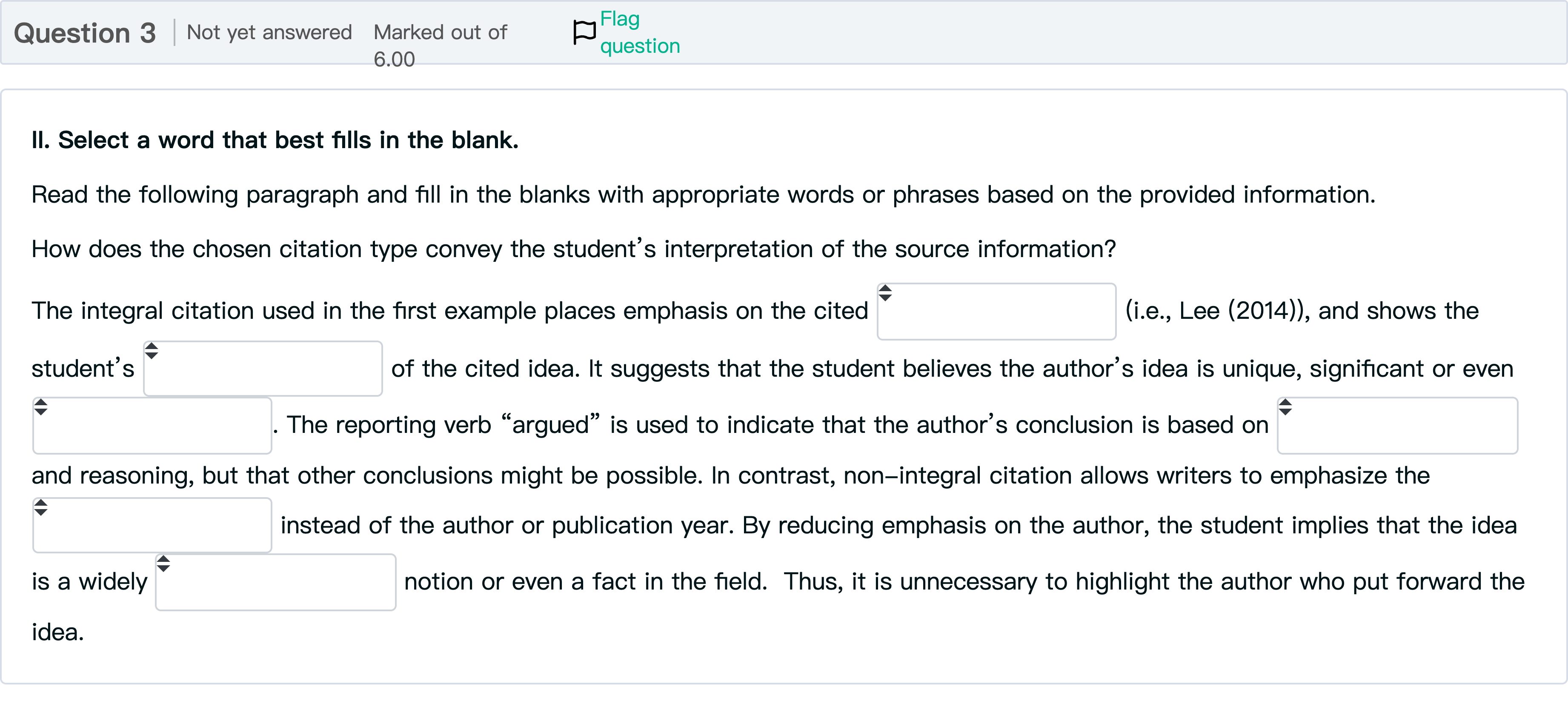
Question text <!-- function msoCommentShow(anchor_id, com_id) { if(msoBrowserCheck()) { c = document.all(com_id); a = document.all(anchor_id); if (null != c && null == c.length && null != a && null == a.length) { var cw = c.offsetWidth; var ch = c.offsetHeight; var aw = a.offsetWidth; var ah = a.offsetHeight; var x = a.offsetLeft; var y = a.offsetTop; var el = a; while (el.tagName != "BODY") { el = el.offsetParent; x = x + el.offsetLeft; y = y + el.offsetTop; } var bw = document.body.clientWidth; var bh = document.body.clientHeight; var bsl = document.body.scrollLeft; var bst = document.body.scrollTop; if (x + cw + ah / 2 > bw + bsl && x + aw - ah / 2 - cw >= bsl ) { c.style.left = x + aw - ah / 2 - cw; } else { c.style.left = x + ah / 2; } if (y + ch + ah / 2 > bh + bst && y + ah / 2 - ch >= bst ) { c.style.top = y + ah / 2 - ch; } else { c.style.top = y + ah / 2; } c.style.visibility = "visible"; } } } function msoCommentHide(com_id) { if(msoBrowserCheck()) { c = document.all(com_id); if (null != c && null == c.length) { c.style.visibility = "hidden"; c.style.left = -1000; c.style.top = -1000; } } } function msoBrowserCheck() { ms = navigator.appVersion.indexOf("MSIE"); vers = navigator.appVersion.substring(ms + 5, ms + 6); ie4 = (ms > 0) && (parseInt(vers) >= 4); return ie4; } if (msoBrowserCheck()) { document.styleSheets.dynCom.addRule(".msocomanchor","background: infobackground"); document.styleSheets.dynCom.addRule(".msocomoff","display: none"); document.styleSheets.dynCom.addRule(".msocomtxt","visibility: hidden"); document.styleSheets.dynCom.addRule(".msocomtxt","position: absolute"); document.styleSheets.dynCom.addRule(".msocomtxt","top: -1000"); document.styleSheets.dynCom.addRule(".msocomtxt","left: -1000"); document.styleSheets.dynCom.addRule(".msocomtxt","width: 33%"); document.styleSheets.dynCom.addRule(".msocomtxt","background: infobackground"); document.styleSheets.dynCom.addRule(".msocomtxt","color: infotext"); document.styleSheets.dynCom.addRule(".msocomtxt","border-top: 1pt solid threedlightshadow"); document.styleSheets.dynCom.addRule(".msocomtxt","border-right: 2pt solid threedshadow"); document.styleSheets.dynCom.addRule(".msocomtxt","border-bottom: 2pt solid threedshadow"); document.styleSheets.dynCom.addRule(".msocomtxt","border-left: 1pt solid threedlightshadow"); document.styleSheets.dynCom.addRule(".msocomtxt","padding: 3pt 3pt 3pt 3pt"); document.styleSheets.dynCom.addRule(".msocomtxt","z-index: 100"); } // --> II. Select a word that best fills in the blank. Read the following paragraph and fill in the blanks with appropriate words or phrases based on the provided information. How does the chosen citation type convey the student’s interpretation of the source information? The integral citation used in the first example places emphasis on the cited Answer 1 Question 3[select: , accepted, author, evidence, groundbreaking, information, interpretation] (i.e., Lee (2014)), and shows the student’s Answer 2 Question 3[select: , accepted, author, evidence, groundbreaking, information, interpretation] of the cited idea. It suggests that the student believes the author’s idea is unique, significant or even Answer 3 Question 3[select: , accepted, author, evidence, groundbreaking, information, interpretation]. The reporting verb “argued” is used to indicate that the author’s conclusion is based on Answer 4 Question 3[select: , accepted, author, evidence, groundbreaking, information, interpretation] and reasoning, but that other conclusions might be possible. In contrast, non-integral citation allows writers to emphasize the Answer 5 Question 3[select: , accepted, author, evidence, groundbreaking, information, interpretation] instead of the author or publication year. By reducing emphasis on the author, the student implies that the idea is a widely Answer 6 Question 3[select: , accepted, author, evidence, groundbreaking, information, interpretation] notion or even a fact in the field. Thus, it is unnecessary to highlight the author who put forward the idea.Multiple fill-in-the-blank
Log in for full answers
We've collected over 50,000 authentic original questions and detailed explanations from around the globe. Log in now and get instant access to the answers!
Similar Questions
Look at the reference at the bottom of Text 1. What type of source is this article most likely from?
Is the following statement true or false? In the products of methylation-hydrolysis, every -OH group corresponds to the position of a glycosidic bond in the starting polysaccharide.
Which of the follwoing structures represents amylopectin?
Which of the following is true about an aldopentose?I. It is a monosaccharide.II. It contains a CHO groupIII. It is a disaccharide.IV. It is an oligosaccharide.
More Practical Tools for Students Powered by AI Study Helper
Making Your Study Simpler
Join us and instantly unlock extensive past papers & exclusive solutions to get a head start on your studies!