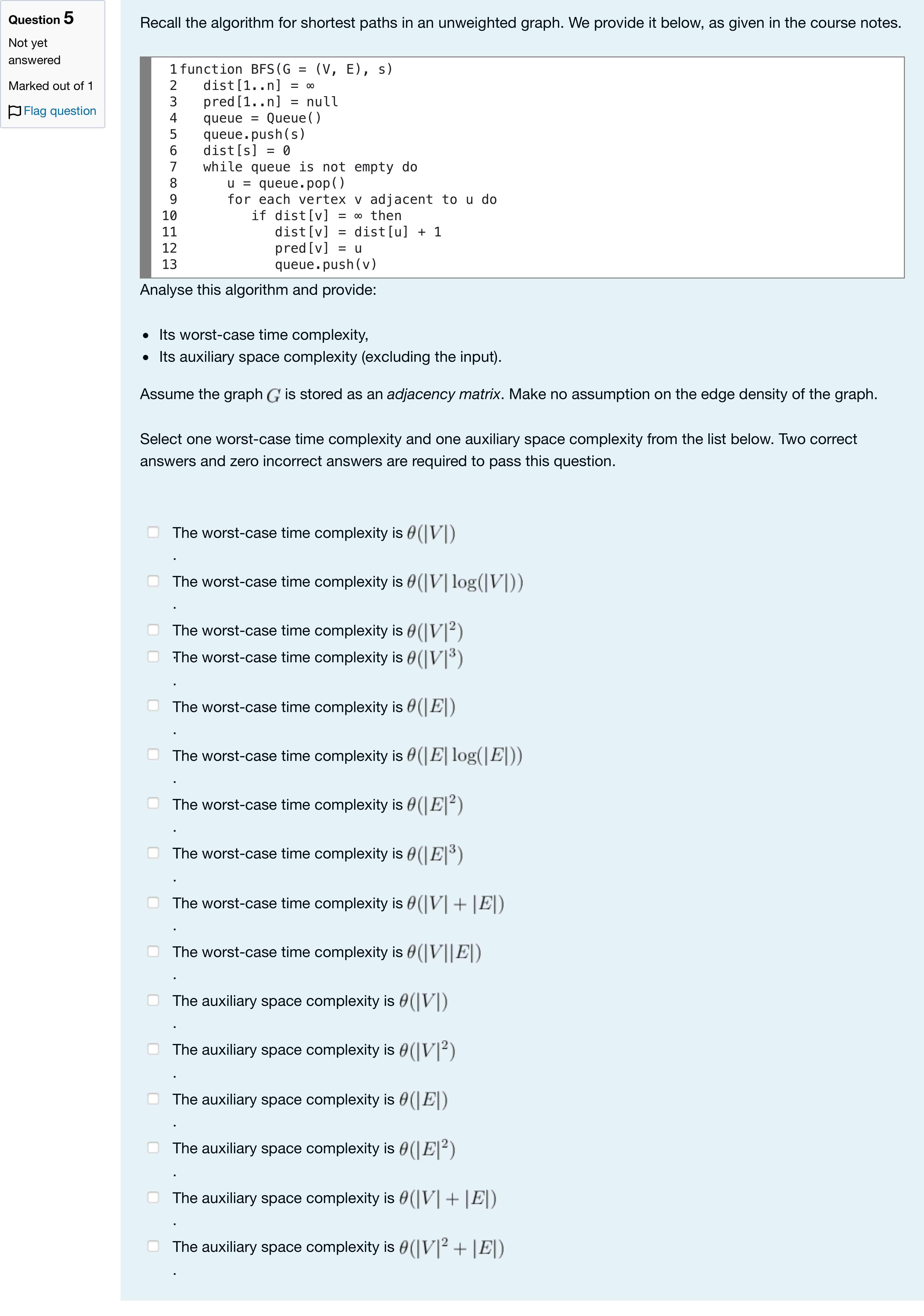
Recall the algorithm for shortest paths in an unweighted graph. We provide it below, as given in the course notes. [table] 1 2 3 4 5 6 7 8 9 10 11 12 13 | function BFS(G = (V, E), s) dist[1..n] = ∞ pred[1..n] = null queue = Queue() queue.push(s) dist[s] = 0 while queue is not empty do u = queue.pop() for each vertex v adjacent to u do if dist[v] = ∞ then dist[v] = dist[u] + 1 pred[v] = u queue.push(v) [/table] Analyse this algorithm and provide:Its worst-case time complexity, Its auxiliary space complexity (excluding the input). Assume the graph is stored as an adjacency matrix. Make no assumption on the edge density of the graph.Select one worst-case time complexity and one auxiliary space complexity from the list below. Two correct answers and zero incorrect answers are required to pass this question.Multiple choice
The worst-case time complexity is .
The worst-case time complexity is .
The worst-case time complexity is .
The worst-case time complexity is .
The worst-case time complexity is .
The worst-case time complexity is .
The worst-case time complexity is .
The worst-case time complexity is .
The worst-case time complexity is .
The worst-case time complexity is .
The auxiliary space complexity is .
The auxiliary space complexity is .
The auxiliary space complexity is .
The auxiliary space complexity is .
The auxiliary space complexity is .
The auxiliary space complexity is .
Log in for full answers
We've collected over 50,000 authentic original questions and detailed explanations from around the globe. Log in now and get instant access to the answers!
Similar Questions
A maze-solving robot uses BFS to find the exit. At level 1 it finds paths to rooms A, B, C. At level 2 from A it finds D, E; from B it finds F; from C it finds G, H. Which room is explored FIFTH?
In a breadth-first search of an undirected graph G, starting at vertex v, which of the following is true when the vertex w is found in level i?
In a breadth-first search of an undirected graph G, starting at vertex v, which of the following is true?
A complete graph is one where every two vertices are connected with an edge. Suppose we run BFS on a complete graph G(V,E) starting from some vertex s in V . What would the BFS layers look like?
More Practical Tools for Students Powered by AI Study Helper
Making Your Study Simpler
Join us and instantly unlock extensive past papers & exclusive solutions to get a head start on your studies!