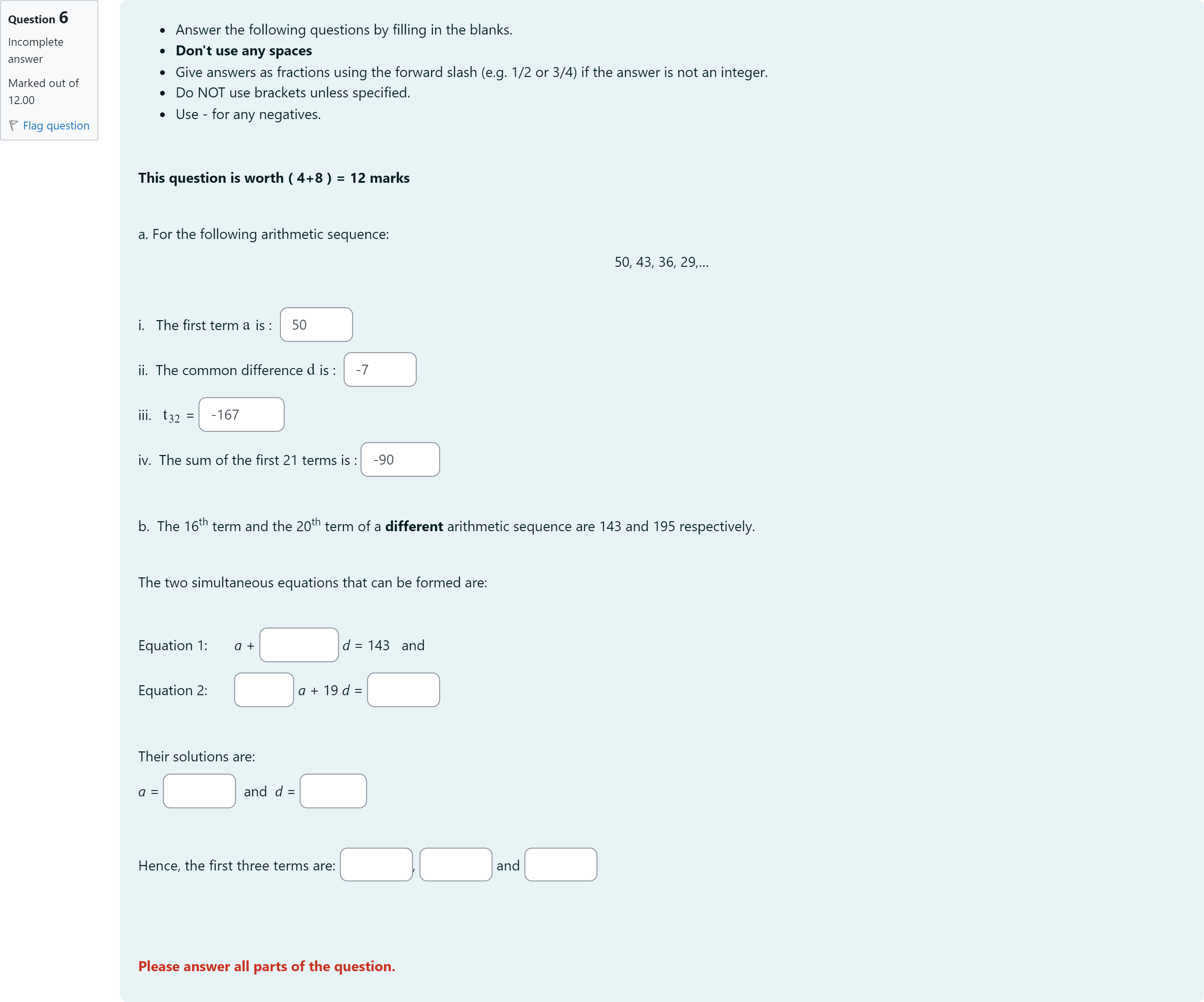
Question textAnswer the following questions by filling in the blanks. Don't use any spaces Give answers as fractions using the forward slash (e.g. 1/2 or 3/4) if the answer is not an integer. Do NOT use brackets unless specified. Use - for any negatives. This question is worth ( 4+8 ) = 12 marks a. For the following arithmetic sequence: 50, 43, 36, 29,…i. The first term [math: a] is : Answer 1 Question 6[input]ii. The common difference [math: d] is : Answer 2 Question 6[input]iii. [math: t32] = Answer 3 Question 6[input]iv. The sum of the first 21 terms is : Answer 4 Question 6[input] b. The 16th term and the 20th term of a different arithmetic sequence are 143 and 195 respectively.The two simultaneous equations that can be formed are:Equation 1: a + Answer 5 Question 6[input] d = 143 and Equation 2: Answer 6 Question 6[input] a + 19 d = Answer 7 Question 6[input] Their solutions are:a = Answer 8 Question 6[input] and d = Answer 9 Question 6[input]Hence, the first three terms are: Answer 10 Question 6[input], Answer 11 Question 6[input] and Answer 12 Question 6[input] Please answer all parts of the question.Multiple fill-in-the-blank
Log in for full answers
We've collected over 50,000 authentic original questions and detailed explanations from around the globe. Log in now and get instant access to the answers!
Similar Questions
Question textMr ENG1014 is working as a consultant for a company that installs street lamps. She is asked to install lamps along a street that is 300 metres long, with the lamps spread out lamps in 25 metre intervals along the street. Three companies have different deals: Company A: each lamp costs $80 to install Company B: first lamp costs $120 to install, and each successive lamp costs $5 less Company C: first 5 lamps cost $150 each, but every lamp after that only costs $13 What is the total cost from each company? Company A: $Answer 1 Question 2[input] Company B: $Answer 2 Question 2[input] Company C: $Answer 3 Question 2[input]Check Question 2
Question textAnswer the following questions by filling in the blanks. Don't use any spaces Do NOT use brackets unless specified. Use - for any negatives. This question is worth [(1 + 1+ 1 + 1) + (1 + 1 + 1) = 7 marks](a) A sequence is generated by the rule tn = 3n-5. (i) What are the first 3 terms of this sequence?Answer:[math: 1st] Answer 1 Question 4[input] [math: 2nd] Answer 2 Question 4[input] [math: 3rd] Answer 3 Question 4[input] (ii) Calculate the sum of the first 32 terms.Answer: Answer 4 Question 4[input] (b) After Jeremy turned 65, he had $200000 to spend. In the first month after turning 65, Jeremy spent $600. From then, each month he spent $20 more than he did the month before.(i) How much does Jeremy spend in the month before he turns 66?Answer: Answer 5 Question 4[input] (ii) How much does Jeremy spend, in total, before he turns 70?Answer: Answer 6 Question 4[input] (iii) How long will Jeremy’s savings last? Give your answer correct to the nearest month. Answer: Answer 7 Question 4[input]
Consider the arithmetic sequence 67, 63, 59,..., 3, -1. How many terms are there in this sequence?
Find the nth term of the sequence0.8, 0.4, 0, -0.4, -0.8...
More Practical Tools for Students Powered by AI Study Helper
Making Your Study Simpler
Join us and instantly unlock extensive past papers & exclusive solutions to get a head start on your studies!