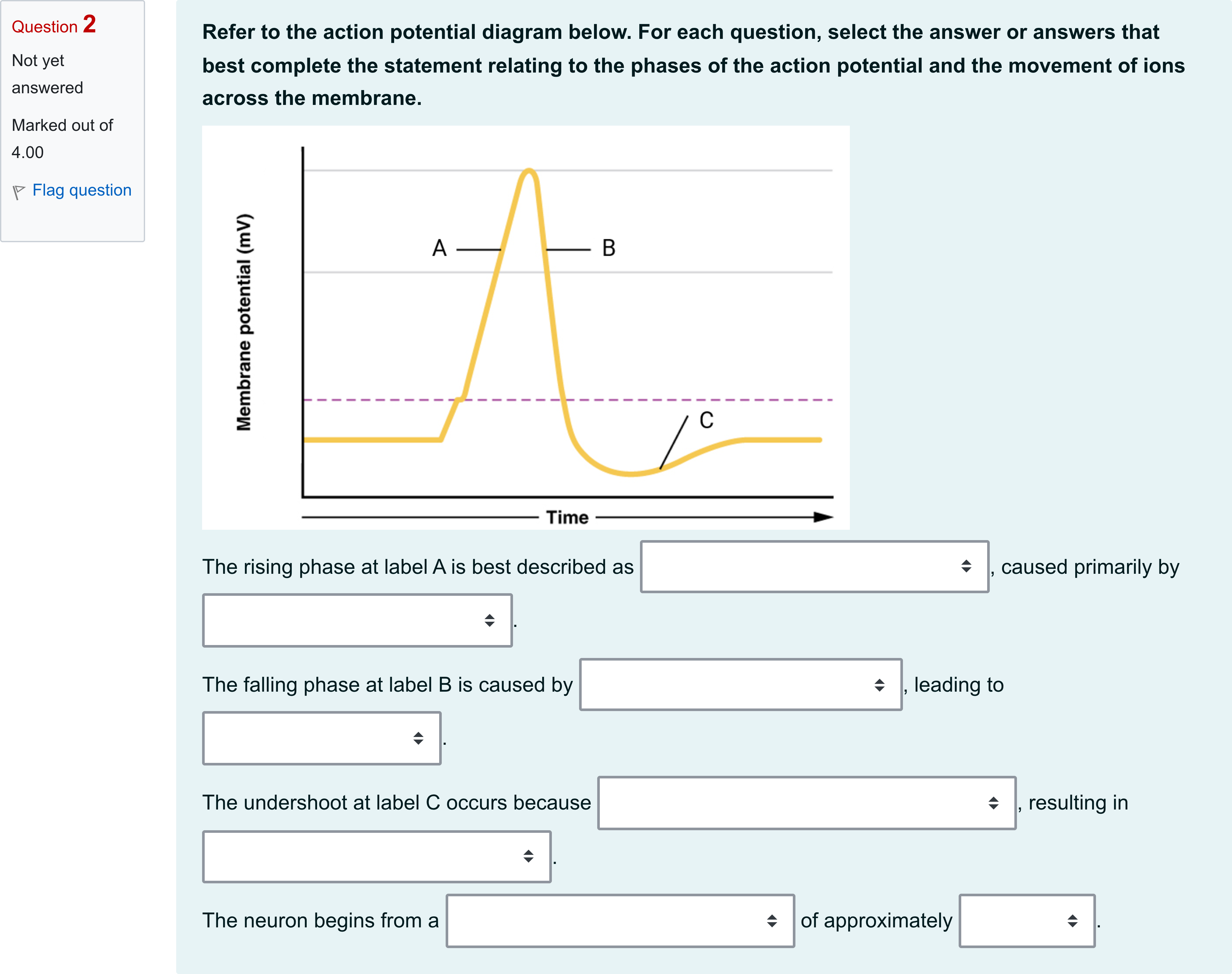
Question textRefer to the action potential diagram below. For each question, select the answer or answers that best complete the statement relating to the phases of the action potential and the movement of ions across the membrane. The rising phase at label A is best described as Answer 1 Question 2[select: , resting membrane potential, depolarisation, repolarisation, hyperpolarisation], caused primarily by Answer 2 Question 2[select: , K+ exiting the neuron, Na+ exiting the neuron, Ca2+ exiting the neuron, Cl- entering the neuron, Na+ entering the neuron]. The falling phase at label B is caused by Answer 3 Question 2[select: , Na+ entering the neuron, K+ exiting the neuron, protein leakage, Ca2+ entering the neuron], leading to Answer 4 Question 2[select: , threshold, hyperpolarisation, summation, repolarisation, depolarisation]. The undershoot at label C occurs because Answer 5 Question 2[select: , Cl- enters through ligand channels, threshold is lowered, K+ channels close slowly, Na+ channels reopen rapidly], resulting in Answer 6 Question 2[select: , resting membrane potential, depolarisation, threshold, plateau potential, hyperpolarisation]. The neuron begins from a Answer 7 Question 2[select: , threshold potential, resting membrane potential, peak overshoot, graded depolarisation] of approximately Answer 8 Question 2[select: , 0 mV, +70mV, -55 mV, +30 mV, -70 mV].Multiple fill-in-the-blank
Log in for full answers
We've collected over 50,000 authentic original questions and detailed explanations from around the globe. Log in now and get instant access to the answers!
Similar Questions
Use the diagram below to answer the following questions. 1: Which letter reflect the neuron's membrane repolarizing (aka the "falling" phase)? 2: Which letter reflect a stable resting membrane potential? 3: Letter that reflect the first sodium voltage-gated channel opening.
Use the picture of the action potential in a specialized cell and letters to select the best choice to match the description that follows. Answers may be used more than once. 1: Voltage gated calcium channels are open 2: Voltage gated potassium channels are open 3: The prepotential
Which of the following scenarios is the most likely consequence of Na+ channels staying open longer during an action potential?
The amplitude of the action potential of a given neuron is
More Practical Tools for Students Powered by AI Study Helper
Making Your Study Simpler
Join us and instantly unlock extensive past papers & exclusive solutions to get a head start on your studies!