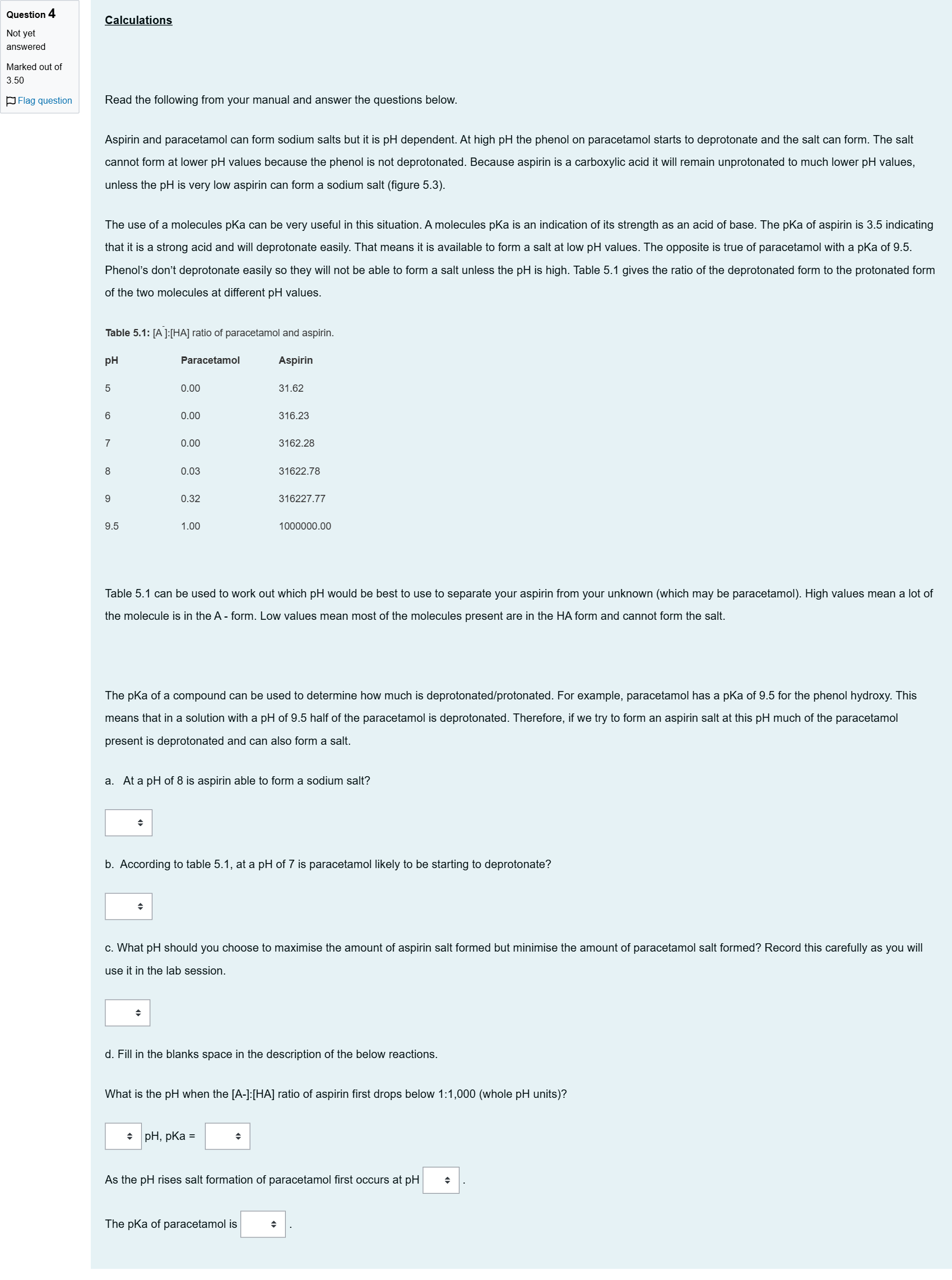
Calculations Read the following from your manual and answer the questions below. Aspirin and paracetamol can form sodium salts but it is pH dependent. At high pH the phenol on paracetamol starts to deprotonate and the salt can form. The salt cannot form at lower pH values because the phenol is not deprotonated. Because aspirin is a carboxylic acid it will remain unprotonated to much lower pH values, unless the pH is very low aspirin can form a sodium salt (figure 5.3). The use of a molecules pKa can be very useful in this situation. A molecules pKa is an indication of its strength as an acid of base. The pKa of aspirin is 3.5 indicating that it is a strong acid and will deprotonate easily. That means it is available to form a salt at low pH values. The opposite is true of paracetamol with a pKa of 9.5. Phenol’s don’t deprotonate easily so they will not be able to form a salt unless the pH is high. Table 5.1 gives the ratio of the deprotonated form to the protonated form of the two molecules at different pH values. Table 5.1: [A-]:[HA] ratio of paracetamol and aspirin. [table] pH | Paracetamol | Aspirin 5 | 0.00 | 31.62 6 | 0.00 | 316.23 7 | 0.00 | 3162.28 8 | 0.03 | 31622.78 9 | 0.32 | 316227.77 9.5 | 1.00 | 1000000.00 [/table] Table 5.1 can be used to work out which pH would be best to use to separate your aspirin from your unknown (which may be paracetamol). High values mean a lot of the molecule is in the A - form. Low values mean most of the molecules present are in the HA form and cannot form the salt. The pKa of a compound can be used to determine how much is deprotonated/protonated. For example, paracetamol has a pKa of 9.5 for the phenol hydroxy. This means that in a solution with a pH of 9.5 half of the paracetamol is deprotonated. Therefore, if we try to form an aspirin salt at this pH much of the paracetamol present is deprotonated and can also form a salt. a. At a pH of 8 is aspirin able to form a sodium salt? Blank 1 Question 4[select: , yes, no] b. According to table 5.1, at a pH of 7 is paracetamol likely to be starting to deprotonate? Blank 2 Question 4[select: , yes, no] c. What pH should you choose to maximise the amount of aspirin salt formed but minimise the amount of paracetamol salt formed? Record this carefully as you will use it in the lab session. Blank 3 Question 4[select: , 7.5, 9, 5, 6] d. Fill in the blanks space in the description of the below reactions. What is the pH when the [A-]:[HA] ratio of aspirin first drops below 1:1,000 (whole pH units)? Blank 4 Question 4[select: , 6, 8, 4] pH, pKa = Blank 5 Question 4[select: , 3.5, 1, 7] As the pH rises salt formation of paracetamol first occurs at pH Blank 6 Question 4[select: , 8, 6, 9] . The pKa of paracetamol is Blank 7 Question 4[select: , 9.5, 8, 12] .Multiple dropdown selections
Log in for full answers
We've collected over 50,000 authentic original questions and detailed explanations from around the globe. Log in now and get instant access to the answers!
Similar Questions
When salicylic acid (pKa = 3.0) is present in the stomach (pH = 1.4), the ratio of the basic (ionised) to acidic (unionised) forms is
A 0.1 M solution of the dibasic acid tartaric acid (C4H6O6) has the following pKa values: pKa1 = 2.8pKa2 = 4.4 Identify which of the following statements is correct.[Fill in the blank]
Arrange these 1.0 M aqueous solutions in order of increasing pH: NaCl(aq), NH4Cl(aq), HCl(aq), CH3CO2Na(aq), KOH(aq)
Question at position 25 Sketch the alpha diagram for H3PO4 (pKa1 = 3, pKa2 = 7, pKa3 = 11). What is the dominant species at pH 4? Sketch the alpha diagram for H3PO4 (pKa1 = 3, pKa2 = 7, pKa3 = 11). What is the dominant species at pH 4? H2PO4-PO43-HPO42-H3PO4
More Practical Tools for Students Powered by AI Study Helper
Making Your Study Simpler
Join us and instantly unlock extensive past papers & exclusive solutions to get a head start on your studies!